

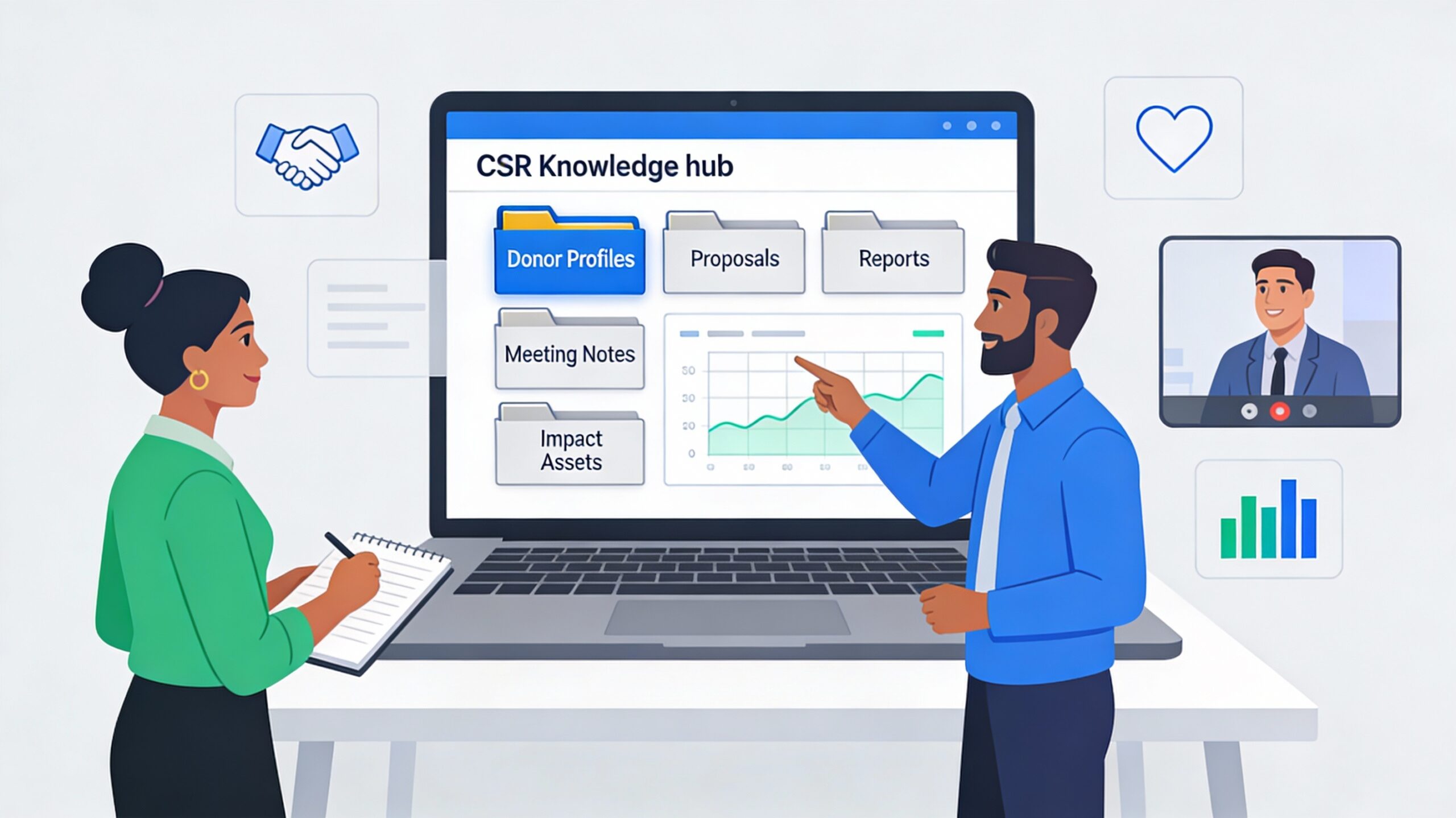
Most NGOs lose CSR opportunities not because of weak programs, but because knowledge is scattered across inboxes, laptops, and people’s heads. A simple, disciplined Knowledge Management (KM) system can quietly multiply your CSR fundraising results.
- Create a Central “CSR Knowledge Hub”
First, create one single place where all CSR-related information lives and can be found in 2–3 clicks. This can be a Google Drive or SharePoint folder structure, or a simple workspace in Notion, Zoho, Airtable, or your CRM—choose whatever your team already uses comfortably.
At minimum, set up these sections:
- Donor Profiles
For each company: CSR policy, focus areas, geography, typical ticket size, contact persons, notes from calls, and decision timelines. - Proposals & Concept Notes
Every proposal submitted—won or lost—with version, date, final PDF, and the internal working files (Word/Excel). - Reports Submitted
Quarterly/annual reports, utilisation reports, photos, annexures, compliance docs. - Meeting Notes & Minutes
Short summaries of calls and meetings with CSR teams, with clear next steps. - Impact Assets
Case studies, photos, videos, data dashboards, impact decks and any storytelling material. - Templates & SOPs
Proposal templates, budget formats, reporting formats, email samples, MoU templates.
Adopt a clear KM rule:
“If it’s not in the hub, it does not exist.”
Suggested KM KPIs:
- Percentage of active CSR donors with a complete, updated profile in the hub.
- Percentage of team members actively using the hub each month.
- Standardise Data Capture for Every CSR Interaction
Right now, a lot of CSR knowledge lives in someone’s memory or WhatsApp chats. To fix this, standardise how information is captured after every interaction.
Create very short formats:
- Donor Interaction Note (max 1 page)
- Date and people present
- Key points discussed
- Their interests and objections
- Commitments made by both sides
- Clear next steps with timelines
- Lead / Prospect Form
- Source of lead
- Company details
- Theme match (education/health/livelihoods, etc.)
- Geography match
- Priority level (A/B/C)
Build a simple discipline into your culture:
Every meeting or call ends with the internal sentence,
“I will update the knowledge hub today.”
Suggested KM KPIs:
- Percentage of donor meetings with notes uploaded within 48 hours.
- Percentage of donors with updated “last contact date” and “next step” recorded.
- Build a “Winning Proposals & Lessons” Library
A good KM system ensures you don’t reinvent the wheel with every new CSR proposal. Instead, you reuse, adapt, and improve.
Do this:
- Tag all proposals
Tag each proposal by theme (education/health/livelihoods/etc.), geography, donor type (PSU, MNC, Indian corporate, foundation), and status (Won / Lost / Under discussion). - Capture 5 key learnings after every major proposal
- For won proposals: What worked? (budget style, narrative, KPIs, alignment with CSR policy, format, etc.)
- For lost proposals: Wherever possible, ask for feedback and record it (price too high, weak alignment, limited geography, due diligence concerns, etc.).
- Create internal “best play” notes (1–2 pages each)
Examples:- “How to write proposals for PSUs”
- “How to position small grassroots projects as scalable”
- “How to explain our M&E system in one page”
Suggested KM KPIs:
- Time taken to prepare a new proposal (before vs after KM system).
- Proposal win rate (percentage accepted) over time.
- Capture Tacit Knowledge So It Doesn’t Walk Away
When a senior fundraiser or program head leaves, half the relationship history often leaves with them. KM needs to protect the organisation from this.
Set up:
- Key Account Files (Account Dossiers)
For each major CSR donor, maintain a 3–5 page dossier with:- Relationship history and key milestones
- Preferences and sensitivities (“what they like / don’t like”)
- Internal decision cycle and typical timelines
- Renewal history and reasons for past decisions
Store this in the central hub, not on personal laptops.
- Debrief Conversations for Handover
When staff leave a key role:- Hold 1–2 structured handover meetings
- Record the discussion or write a summary
- Update donor dossiers and the hub
- Monthly “CSR Learning Circle”
Once a month, bring together fundraising, leadership, and program teams to share:- New leads and opportunities
- Donor feedback and questions
- Proposal wins/losses and learnings
- Sector and CSR trends
Summarise key points and upload them to the hub.
Suggested KM KPIs:
- Percentage of key donors with a written relationship history.
- “No disruption” rate when donor ownership changes between staff.
- Set Clear Roles, Ownership, and Simple KM Processes
KM collapses when “everyone is responsible”—which usually means no one is accountable. Make ownership explicit.
- Appoint a KM Owner for CSR
This could be the Head – Partnerships or a specific team member. Their responsibilities:- Ensure folders and records are regularly updated
- Send gentle reminders and support the team
- Keep the structure clean and logical (no random, messy files)
- Pull out key insights every quarter
- Define simple, non-negotiable processes
- After every meeting → upload notes within 48 hours
- After every proposal submission → upload final copy, tags, and 3–5 learnings
- After every project completion → upload final report plus core learnings
- Use clear naming conventions
Examples:- 2025-04_CompanyName_ProjectName_Proposal_vFinal
- 2025-05_CompanyName_Q1_Report
This reduces search time and confusion.
Suggested KM KPIs:
- Percentage of documents following standard naming conventions.
- Average time it takes team members to find a needed document (self-rated).
- Use Knowledge to Improve Strategy, Not Just Storage
KM is not filing; it is fuel for better strategy. Every quarter, sit with your KM data and ask:
- Which proposals and themes are converting best?
Analyse by sector, geography, donor type, and ticket size. - Where are we getting stuck?
Are rejections happening at budget stage, due diligence stage, or concept note stage? Are timelines slipping at any particular step? - What do our top donors value most?
Do they repeatedly emphasise M&E, storytelling, cost efficiency, innovation, geography, or government partnerships?
Translate these insights into concrete actions:
- Refine your target list of companies and sectors.
- Adjust standard budget formats and unit costs.
- Sharpen your pitch and positioning to match what donors value.
- Strengthen weak areas (for example, branding, documentation, or compliance).
Suggested KM KPIs:
- Number of quarterly review reports generated from KM data.
- Visible strategy changes (new focus areas, refinements) made based on KM insights. 7. A Simple 180-Day Implementation Roadmap
You do not need a big tech project to start; treat it as a series of small habits.
First 30 days
- Decide the platform (Drive / Notion / CRM / etc.).
- Create the basic folder or section structure.
- Upload all existing donor, proposal, and report files into the right places.
Next 60 days
- Introduce simple forms and templates (meeting note, lead form, proposal tags).
- Conduct 1–2 short training sessions for the team.
- Officially appoint the KM Owner for CSR.
Next 90 days
- Start a quarterly “CSR Insight Brief” (2–3 pages) using your KM data.
- Use this brief to shape your CSR fundraising strategy for the next quarter.
- Share highlights with leadership so KM is seen as a strategic asset, not “extra admin work”.
Written by Deb who is a social impact worker and part of letzrise team and stays in Bengaluru.