

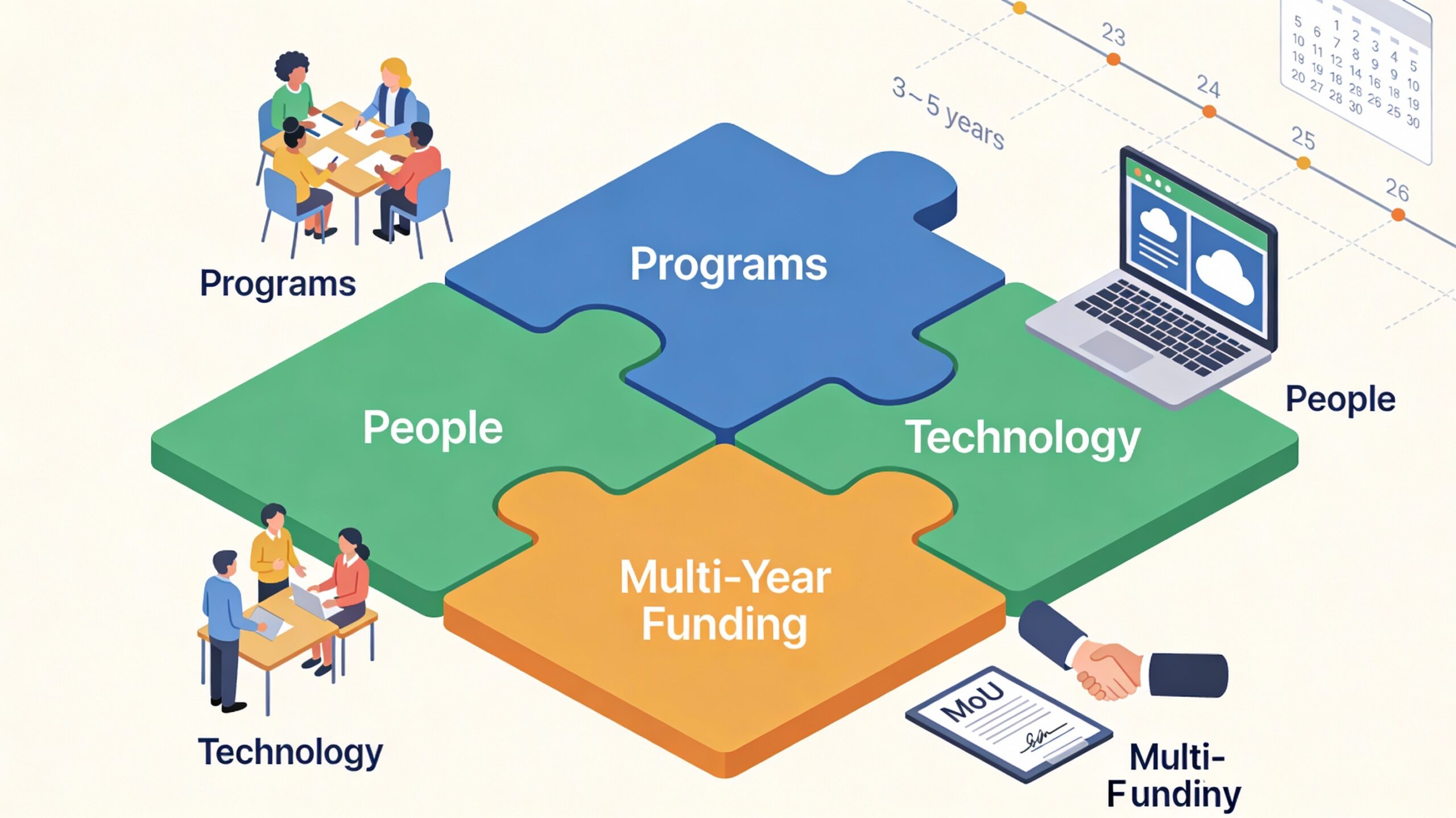
Many CSR donors in India are slowly moving towards multi-year, programmatic partnerships and more openness to funding organisational development, but NGOs still need to design for this shift very intentionally. This blog lays out a practical roadmap to move from one-year projects and “no overheads” to longer-term programme funding and real investment in teams, systems and technology.
From short-term projects to programmatic journeys
Most NGOs pitch CSR as 12-month projects, so companies also think in 12-month cycles. To change that, start packaging your core work (education, health, livelihoods, climate, etc.) as a 3–5 year programme, not a string of disconnected grants.
Build a simple roadmap: Year 1 for pilot/proof of concept, Years 2–3 for consolidation and scale, and Years 4–5 for deepening quality and government/community integration. Then create a crisp “Program Deck” with a clear name, phases, milestones, scale plan and annual visibility for the corporate. Even if they can only sign year-by-year MoUs, you are now inviting them into a long-term journey. Attach this roadmap as an annexure to every project proposal: “We are seeking Year 1 funding of ₹X as part of a 3-year programmatic plan.”
Offer “pilot → scale → flagship” options
Instead of a single take-it-or-leave-it budget, design 2–3 funding options in every proposal. Option 1 is a tight Year 1 pilot with limited geography, focused outcomes and strong M&E; Option 2 is a 2–3 year scale-up with more locations and better cost per beneficiary; Option 3 is a flagship model over 3–5 years with deeper government/community integration and stronger branding.
This structure gently nudges CSR teams to think beyond a one-year experiment and imagine a pathway into scale and leadership. Track the percentage of pilots that convert to renewal, and how your average partnership duration shifts from one year towards two or three.
Choose the right CSR partners for programmes
Some CSR partners are structurally better suited for programmatic work than others. Corporate foundations and dedicated CSR trusts often already talk about “flagship programmes” and “long-term commitments” in their reports, and PSUs or large manufacturers with stable, geography-based CSR portfolios typically value continuity.
Create a “Programmatic Funding Prospect List” of 20–30 companies where your theme and geography match and where there is a track record of multi-year grants or long-term NGO partnerships. Pitch these prospects your flagship programmes only, not scattered activities, and measure how many programmatic approaches convert into multi-year MoUs.
Make renewal the default outcome
Renewals rarely happen by accident; they happen because NGOs plan them. Around Month 6–8 of a 12-month CSR project, schedule a structured conversation that shares interim results and a 2–3 year vision, including a short Year 2–3 concept note. Show clearly what will be lost if the project stops now—service drop-offs, regression in communities—and what will be gained by continuing: bigger outcomes, better unit costs, stronger systems and community ownership.
Internally, track what percentage of your CSR partners renew beyond Year 1 and how much of your total CSR income comes from renewals versus new donors. Over time, this tells you whether you are truly shifting from project to programmatic relationships.
Embedding org development, staff and tech into CSR
Indian CSR law caps “administrative overheads” at 5 percent, but many costs related to project management, M&E, tech and staff training are legitimate programme expenses when clearly linked to outcomes. In every proposal, explicitly build in project coordination, monitoring and evaluation, and technology for delivery and tracking (MIS, tablets, licences, dashboards), as well as field staff training directly tied to the intervention.
Keep these combined (management/admin + M&E + tech) within broadly acceptable ranges, often 10–20 percent of project budgets depending on sector and donor, and justify them in terms of improved quality, accountability and scalability of impact. Your internal KPI: what proportion of approved projects include explicit OD/staff/tech lines, and how much you raise annually for systems and training through project budgets.
Pitch a dedicated “institutional strengthening” concept
A small but growing number of CSR leaders are willing to invest in organisational backbone when they see it as essential to scale impact. For 1–2 of your most trusted partners, create a short concept like “Institutional Capacity Strengthening for Scalable Impact”, covering MIS and reporting systems, key hires or retention (programme manager, M&E lead, tech lead), leadership development, and communication/storytelling capacity.
Frame this as an invitation: “You’ve seen our field work; to scale it and meet your ESG/BRSR expectations, we need to strengthen our institution—you can be our ‘Institution Builder’.” Target existing, satisfied partners and more flexible corporate foundations, and track how many you approach and how much OD/capacity/tech funding you secure.
Use in-kind and pro-bono support for tech and systems
Not every form of capacity building needs cash. Many IT and consulting companies are open to pro-bono or in-kind CSR: building simple MIS or dashboards, donating licences for CRM and data tools, or offering advisory support on HR, data security or process design. Corporate volunteers can also support with data cleaning, simple automation (Sheets, Power BI), or staff trainings on tools like Excel or Canva.
Coordinate this through CSR, HR/volunteering and internal tech teams so that engagements are structured and outcome-focused. Internally, track the number of such engagements, an estimated rupee value of in-kind support, and the number of systems/tools you upgrade using this help.
Build your own flexible “capacity fund”
Because CSR is legally and culturally restrictive on overheads, NGOs need non-CSR money for core capacity. Flexible sources—HNIs, philanthropists, retail donors, and clearly branded “build our backbone” campaigns—are better suited to funding core team salaries, leadership development, tech investments and reserves.
Set a specific annual target for an “Institutional Capacity Fund” (for example, ₹X lakhs per year) and be transparent about its purpose in your communication and appeals. Then track how much you raise in flexible funds, what share of your total budget they represent, and how many months of core team runway you can cover from reserves.
Show the ROI of investing in capacity
Donors are more willing to support systems and people when they see clear returns. After you invest in MIS, M&E or team capacity, document simple before–after metrics: reporting turnaround reduced from 20 days to 7, data corrections down, ability to handle double the beneficiaries with the same team, or improved quality of evaluations.
Bring these numbers into annual reviews and presentations: “Because you invested in X, we can now do Y,” connecting capacity funding to better risk management, efficiency and scale. Over time, this helps shift CSR partners from a narrow view of “overheads” to a more mature “pay what it takes” mindset that strengthens both programmes and organisations.
Written by Deb who is a social impact worker and part of Letzrise team and stays in Bengaluru.