


Date:- 20th March 2025, 17:05, Bengaluru, India
Fundraising is the lifeline of any charity, but for small organizations with an annual budget of less than ₹1 crore, it often feels like an uphill battle. Most rely on personal networks and one-time contributions, lacking the systems needed for long-term financial sustainability. So, how can small and medium-sized charities step up their fundraising game and ensure a steady stream of support? Let’s break it down in a way that’s practical, achievable, and impactful.
Why Is Fundraising Readiness Important?
When we talk about fundraising preparedness, we mean more than just having a donor list. It’s about having the right legal structure, compliance, fundraising strategy, and digital presence to attract consistent funding—both restricted (for specific programs) and unrestricted (for core operations and growth).
What My Research Revealed
In my research across different-sized charities, I found that:
- Large Charities (₹50+ crore budgets): They have well-established fundraising systems, multiple revenue streams, and are mostly registered as Section 8 companies with FCRA approval.
- Medium Charities (₹1-50 crore budgets): They have moderate fundraising capacity, mostly securing restricted funds through CSR and grants. Most are registered as Trusts or Societies, with or without FCRA.
- Small Charities (Under ₹1 crore budgets): They often lack structured fundraising and rely on personal networks. Most are Trusts or Societies without FCRA, making it harder to secure external funding.
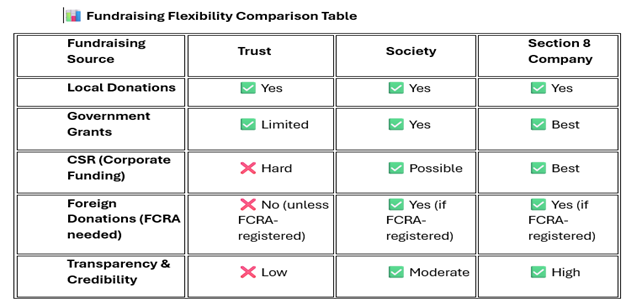
One key insight: Charities registered as Section 8 companies with FCRA approval have a much easier time securing funding. Donors, especially corporates and foundations, prefer this structure due to compliance ease.
Table -1- The below table will tell you about legal and operational challenges.
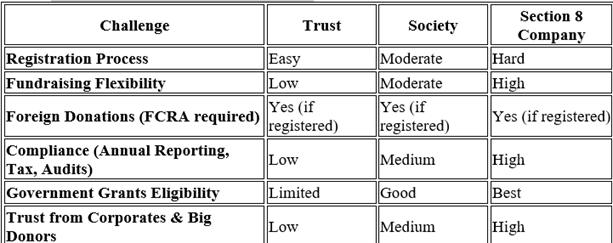
Table 2- the below table will tell you about fundraising flexibility.
What Does This Mean for Small Charities?
If you’re a small charity struggling with fundraising, here’s what you need to do:
- Get Your Legal & Compliance Foundations Right- Without proper registration and documentation, your fundraising options are limited. If your NGO has completed three years of operations, consider transitioning to a Section 8 company and applying for:
✅ CSR Form 1
✅ 10BD / 80G (for tax exemptions to donors)
✅ 12A (for income tax exemption)
✅ NGO Darpan Registration
✅ FCRA (if you plan to receive foreign donations)
Other essentials include:
- PAN Card for the NGO
- NGO bank account
- Quarterly board meeting records
- Audited financial reports
- Impact reports of your programs
Yes, there’s a cost involved, but once you set these up, fundraising becomes significantly easier. Most charities recover this investment within six months!
Costing of compliance process:-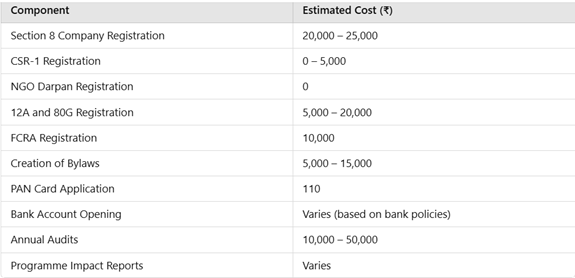
Cost of Fundraising:-
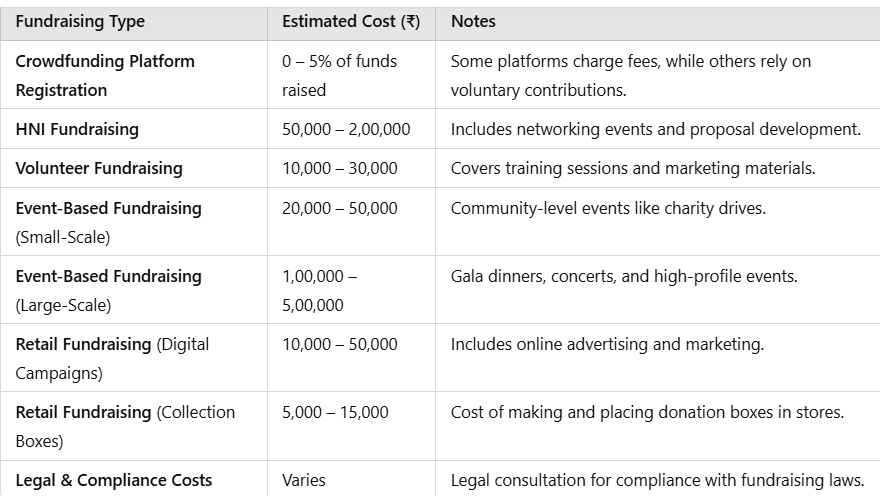
- Build a Smart Fundraising Strategy-Successful fundraising isn’t about luck—it’s about strategy. You need to tap into both restricted and unrestricted funding sources.
🔹 Restricted Funds (Program-Specific Grants & Donations)-These funds are allocated for specific programs and come from:
- Corporate CSR grants
- Government & semi-government grants
- Multilateral & bilateral organizations
- Local philanthropic foundations
Most require a formal proposal or NGO registration on grant portals.
🔹 Unrestricted Funds (Flexible Donations for Growth & Operations)- Unrestricted funds give your organization breathing room and can be raised through:
- Crowdfunding platforms
- High-Net-Worth Individual (HNI) donations
- Volunteer-led fundraising campaigns
- Event-based fundraising
- Retail fundraising (e.g., monthly giving programs, merchandise sales)
Key takeaway? A mix of restricted and unrestricted funds ensures stability and flexibility in your operations.
- Invest in Your Digital Presence-In today’s digital world, a charity without an online presence is invisible. Donors, both big and small, expect to find information about your work online. Here’s what you need:
🔹 A professional, updated website with impact stories and donation options
🔹 Active social media presence (Facebook, Instagram, LinkedIn)
🔹 A CRM system to track donors and communications
Many donors make their giving decisions based on how engaging and transparent your online presence is!
- Understand the Investment Rule: 1:3- Fundraising requires investment. A good rule of thumb: For every ₹1 you invest in fundraising, you should aim to generate ₹3 in return. For example, if you invest ₹10,000 in a crowdfunding campaign, your goal should be to raise at least ₹30,000. Scaling this up requires strategic planning, consistency, and patience.
- The Mindset Shift: What It Takes to Succeed in Fundraising- Fundraising is NOT an overnight success story—it’s a long-term process that requires:
1️ Appetite for Learning: Not every fundraising effort will work. Learn from failures and refine your approach.
2️ Appetite for Investment: You need to invest time, money, and effort to see returns.
3️ Patience & Consistency: If you start fundraising today, expect significant results only in 6-12 months. But once your system is in place, revenue becomes more predictable.
Need Help in Setting Up Your Fundraising System?
If you want to build a robust fundraising system, our team can help with:
📌 Compliance Setup & Support – ₹35,000/month
📌 Fundraising Strategy & Execution – ₹70,000/month (with a performance guarantee)
📌 Digital Presence (Website & Social Media Management) – ₹50,000/month
📌 All-in-One Support (Compliance + Fundraising + Digital Presence) – ₹1,00,000/month
📩 Interested? Let’s Talk!
Building a sustainable fundraising system isn’t easy, but with the right strategy, structure, and patience, any charity—big or small—can thrive.
Authored by Deb, a fundraising strategist and nonprofit growth advisor with over 20 years of experience, this roadmap draws on deep expertise in ethical giving, storytelling, and donor engagement to help mission-driven organizations scale with purpose.