

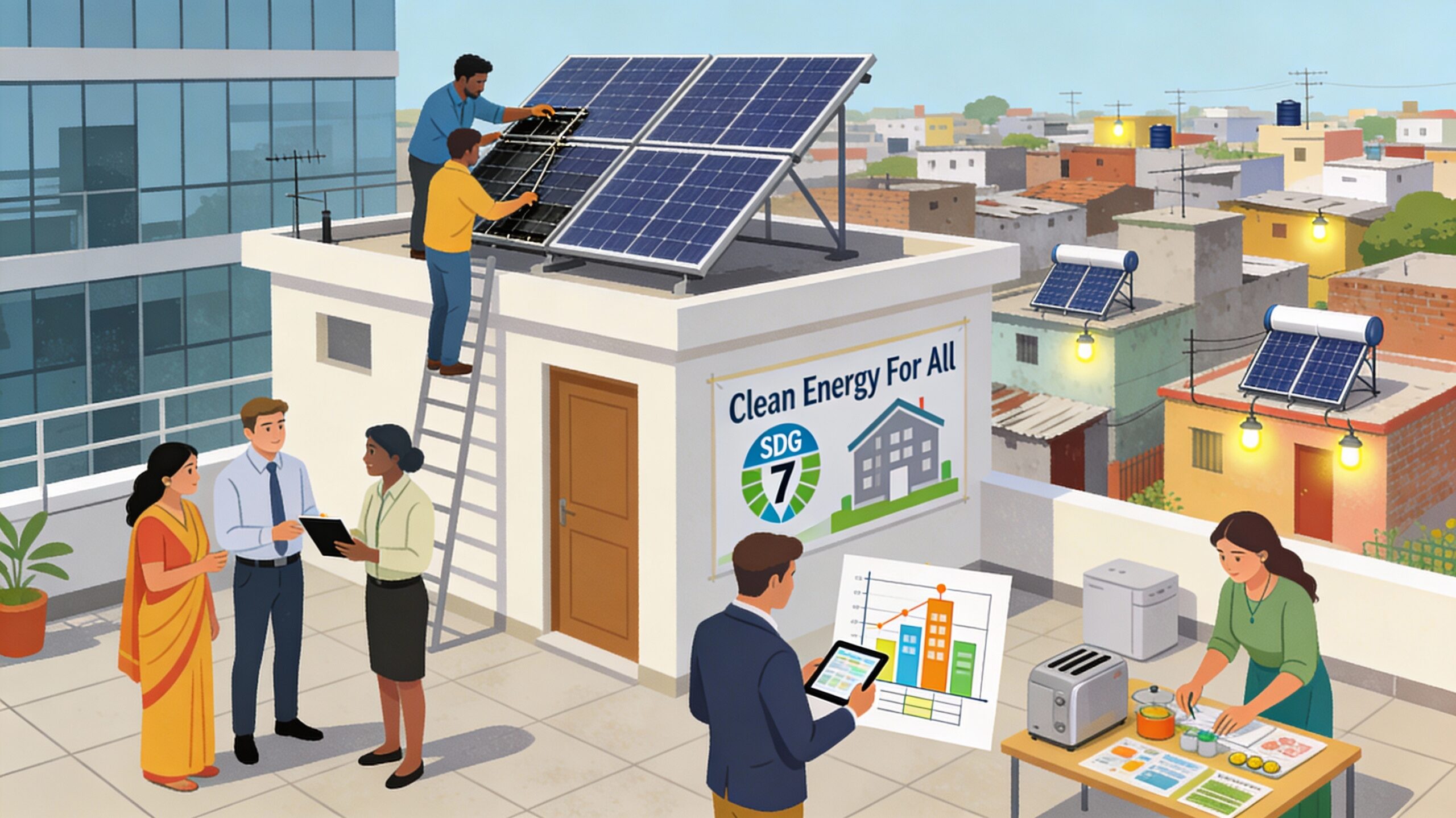
Why SDG 7 Is A Powerful Theme for Employee Engagement
SDG 7, “Affordable and Clean Energy,” aims to ensure access to affordable, reliable, sustainable, and modern energy for all. It covers universal energy access (7.1), increasing the share of renewables (7.2), improving energy efficiency (7.3), and strengthening international cooperation and infrastructure for clean energy.
For companies, SDG 7 links directly to operations, buildings, data centres, and products—but also to employees’ own homes and communities. NGOs can help CSR partners move from generic “save electricity” messages to structured engagement where employees support energy efficiency and clean-energy access, especially for low-income and energy-poor households.
Shift The Lens: From “Switch Off The Lights” To Energy Equity
Most employee engagement on energy still revolves around campaigns to switch off lights, set AC temperatures higher, or celebrate Earth Hour. These are useful as starting points but do little to address energy poverty, unreliable supply, or the need to shift to renewables at scale.
An SDG 7–aligned approach asks deeper questions:
- Who still lacks reliable, safe, and affordable energy in and around our project areas?
- Where can efficiency and rooftop solar meaningfully reduce emissions and bills?
- How can employees support planning, awareness, and uptake of clean energy solutions?
NGOs can design programs where employees help co-create practical solutions and awareness in their own workplace and in nearby communities.
Step 1: Anchor The Program In SDG 7 Targets
Frame your employee engagement plan explicitly around SDG 7 targets:
- 7.1 – Ensure universal access to affordable, reliable, and modern energy services.
- 7.2 – Increase substantially the share of renewable energy in the global energy mix.
- 7.3 – Double the global rate of improvement in energy efficiency.
Position employee engagement as contributing to 7.3 in offices (through audits and behaviour change) and to 7.1 and 7.2 in communities (through awareness, planning support, and, where relevant, rooftop or decentralized solutions).
Step 2: Map Energy Use, Gaps, And Employee Levers
Before designing activities, NGOs should map:
- Workplace energy profile: major loads (HVAC, lighting, equipment), existing efficiency or renewable measures, and data availability.
- Community energy realities: nearby low-income or peri-urban communities’ access to electricity, reliability, safety, use of clean vs. polluting cooking fuels, and awareness of schemes.
- Employee levers: facility-level decisions, green office initiatives, technical expertise (engineering, data, finance), and personal influence in households and communities.
This ensures engagement is grounded in real SDG 7 gaps instead of generic “go green” messaging.
Step 3: Design A Clean-Energy Engagement Journey
A strong SDG 7 employee program can be framed as a journey:
- Phase 1 – Energy literacy: sessions that explain SDG 7, basic grid/renewable concepts, and energy poverty in your region.
- Phase 2 – Workplace efficiency and rooftop projects: employee-led audits, behaviour changes, and small upgrades.
- Phase 3 – Community engagement: supporting awareness and planning for clean, safe energy in nearby settlements.
- Phase 4 – Innovation and advocacy: employees co-creating tools, financing ideas, or models that support SDG 7 at scale.
This connects personal behaviour, workplace systems, and community-level change.
High-Impact SDG 7 Employee Engagement Formats
- Energy Literacy Labs And “Bill Stories”
Start with energy literacy labs that demystify terms like kWh, peak load, and renewables, and link them to SDG 7 targets. Use simple visuals to show how coal-heavy grids, diesel generators, and inefficient buildings drive emissions and cost.
Invite community members or field staff to share stories about coping with unreliable supply, unsafe wiring, or high energy bills—this makes energy poverty real, not abstract. Employees can also share their own “bill stories,” comparing typical household consumption and exploring realistic reductions.
- Employee-Led Energy Audits And Green-Office Fixes
Employees can help implement Target 7.3 (efficiency) by conducting simple audits in offices:
- Mapping lighting, equipment left on, thermostat settings, and plug loads.
- Identifying low-cost fixes such as LED retrofits, zoning of lighting/AC, and power management on devices.
- Working with facilities to test small changes and track impact via bills or meters.
NGOs can provide templates and basic training, while CSR and facilities teams handle approvals and data.
- Rooftop Solar And Clean-Energy Demonstration Projects
If rooftops or campuses are suitable, employee engagement can include supporting feasibility assessments for rooftop solar or other small renewable installations. Activities could include:
- Learning sessions on how rooftop solar works, basic financials, and maintenance.
- Visits to existing installations or virtual tours.
- Co-design of dashboards that show solar generation and savings to staff.
In some partnerships, small demonstrations of solar home systems or efficient lighting can be installed in nearby community centres or schools, with employees involved in awareness and handholding.
- Community Clean-Energy Awareness And Planning
SDG 7 is also about getting clean, safe energy to those who lack it. NGOs can train employees to support:
- Awareness campaigns on safe wiring, efficient lighting, and access to government schemes for electricity or clean cooking.
- Basic household or community energy assessments: counting points of light, appliances, and fuel use, and mapping pain points.
- Group meetings where residents explore options like improved connections, efficient appliances, or community solar solutions.
Employees act as facilitators and documenters, while decisions remain with communities and technical partners.
- Innovation And Financing Sprints For SDG 7
Employees across finance, product, and digital can contribute to SDG 7 innovation:
- Exploring simple EMI or pay-as-you-go models for efficient appliances or solar solutions, in collaboration with MFIs or fintechs.
- Designing basic tools (apps, calculators) that help households understand potential savings from efficiency or clean energy switches.
- Drafting internal guidelines for evaluating clean-energy CSR proposals.
These formats connect SDG 7 with business thinking while keeping community realities central.
Step 4: Governance, Safety, And Technical Integrity
Energy projects carry safety and technical risks. NGOs should:
- Partner with qualified technical organisations for any hardware installation; employees should not be asked to perform electrical work without proper training and supervision.
- Ensure community engagements about products or schemes are accurate and do not over-promise outcomes or subsidies.
- Clarify boundaries between awareness/facilitation roles and technical/financial decision-making.
A joint governance group (CSR, facilities, sustainability, NGO, technical partners) can oversee project quality and resolve issues.
Step 5: Metrics That Reflect SDG 7 Outcomes
Avoid limiting metrics to “number of volunteers” or “sessions held.” Track SDG 7–aligned indicators such as:
- Estimated energy savings from behaviour changes or minor efficiency upgrades in offices.
- Renewable generation from any rooftop or demo systems installed (kWh/year).
- Number of community households reached with clean-energy awareness, and those adopting efficient or clean solutions where data is available.
- Employee energy-literacy improvements and self-reported behaviour changes at home.
Where possible, align these with national or company SDG 7 indicators for ESG reporting.
Step 6: Storytelling That Links Energy, Dignity, And Climate
Energy access is about more than technology—it is about dignity, safety, time, and opportunity. Stories from SDG 7 engagement should:
- Highlight how reliable, clean energy changes daily life: study hours, women’s safety, health, and small businesses.
- Show employees learning from communities as much as they contribute.
- Connect each story back to SDG 7 targets and to climate and health co-benefits.
This fosters a deeper, values-based commitment to clean energy, beyond gadgets and bills.
Written by Deb who is a social impact worker and part of letzrise team and stays in Bengaluru.