

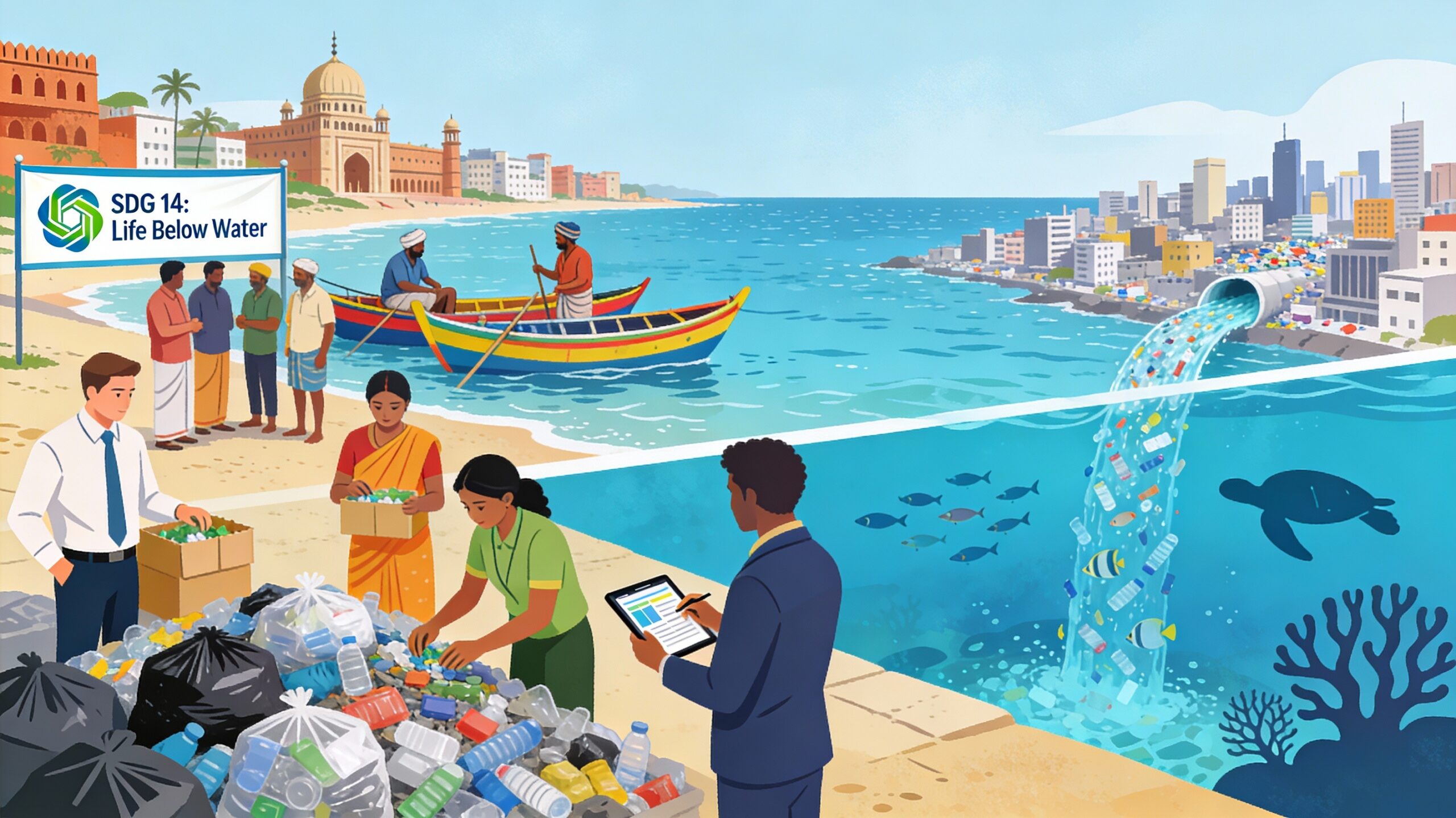
Why SDG 14 Belongs In Your Employee Engagement Strategy!
SDG 14, “Life Below Water,” is about conserving and sustainably using oceans, seas, and marine resources—from reducing pollution and overfishing to protecting coastal ecosystems and boosting ocean-based livelihoods. Oceans regulate climate, provide food and jobs to billions, and absorb a large share of human-made carbon dioxide, yet they face mounting pressures from plastic pollution, acidification, and unsustainable fishing.
For CSR teams, SDG 14 is not just a coastal issue; much of the marine crisis is driven by land-based activities like mismanaged waste, urban runoff, and unsustainable consumption patterns. NGOs can help corporates turn employee engagement into blue stewardship—linking everyday choices, business practices, and community action to healthier oceans and coasts.
Shift The Mindset: From One-Off Clean-Ups To Ocean Systems Change
Most SDG 14–branded CSR still focuses on one-off beach or lake clean-ups where employees collect trash for a day and pose for photos. While clean-ups can be powerful entry points, they barely touch the upstream drivers of marine pollution, such as product design, logistics, waste systems, and consumer behaviour.
An SDG 14–aligned approach sees clean-ups as part of a broader systems journey: understanding local watersheds, reducing plastic at source, strengthening community waste systems, supporting fishers and coastal livelihoods, and advocating for better policies. Employee engagement then becomes a multi-layered program that connects what happens “on land” with impacts “below water.”
Step 1: Anchor Partnerships In SDG 14 Targets
Start by introducing SDG 14 using concrete targets that resonate with your context and the company’s footprint. Key ones for employee engagement often include:
- 14.1 – Prevent and significantly reduce marine pollution of all kinds, especially from land-based activities such as marine debris and nutrient pollution.
- 14.2 – Sustainably manage and protect marine and coastal ecosystems, strengthening their resilience and restoring them to achieve healthy and productive oceans.
- 14.7 – Increase the economic benefits from sustainable use of marine resources, including fisheries, aquaculture, and tourism, especially for coastal communities.
- 14.a – Increase scientific knowledge, research capacity, and technology transfer for ocean health.
By tying your engagement plan explicitly to these targets, CSR and ESG teams can see how employee activities contribute to globally recognised priorities rather than isolated local projects.
Step 2: Map Your Land–Sea Linkages And Corporate Levers
For most companies, the biggest SDG 14 impacts are indirect—through packaging, supply chains, waste, and logistics that feed into rivers and coasts. As an NGO, help the corporate partner map their land–sea linkages: where operations intersect with river basins, industrial areas, ports, or coastal communities, and how their products or waste might travel downstream.
Next, identify the company’s strengths and levers: product design, procurement, logistics, data and technology, marketing reach, or work with informal waste workers. Employee engagement is most effective when it uses these strengths—employees can co-create solutions on plastics reduction, circular packaging, or waste segregation systems that directly reduce marine litter risk.
Step 3: Design A Phased Ocean Stewardship Journey
SDG 14 issues are complex and can feel distant for inland employees, so design a phased journey that progressively deepens understanding and ownership. A simple structure:
- Phase 1 – Awareness: ocean literacy sessions, screenings, and interactive workshops connecting local rivers and drains to coasts and seas.
- Phase 2 – Action on land: workplace and community initiatives on waste reduction, segregation, circularity, and data collection.
- Phase 3 – Coastal engagement: structured field work with coastal communities, fishers, and local authorities, focusing on restoration, livelihoods, and monitoring.
This approach allows employees to see that “Life Below Water” starts with choices and systems on land, not just at the shoreline.
High-Impact SDG 14 Employee Engagement Formats
- Ocean Literacy Labs And Watershed Walks
Start with “Ocean Literacy Labs” that explain how oceans regulate climate, support food systems, and absorb carbon, and how land-based pollution flows through rivers into the sea. Combine short, interactive sessions with local watershed or lakeside walks where employees observe drains, plastic accumulation points, and informal waste systems.
Use accessible infographics, local data, and SDG 14 target posters to connect these observations to global goals. This builds a systems lens and sets the stage for meaningful action, especially for employees who are far from the coast.
- From Clean-Ups To Circularity Campaigns
Beach, river, or lake clean-ups can be powerful if used as a starting point for upstream change. Structure clean-ups with:
- Proper pre-briefs on safety, data collection, and respect for local communities.
- Waste audits where teams categorise collected waste by material and brand to understand patterns.
- Post-event workshops where employees brainstorm reduction and circularity actions in the company and their homes.
Link this to concrete initiatives like plastic-free office campaigns, reusable packaging pilots, or support for EPR (Extended Producer Responsibility) compliance, aligning with broader circular economy efforts.
- Citizen Science For Coastal And River Health
Citizen science is a direct way to support SDG 14 targets on pollution and ecosystem health. Train employees to collect simple data: litter counts, water clarity, basic water-quality indicators, or species sightings at specific sites along rivers, lakes, and coasts.
Corporate data and tech teams can help design or adopt apps and dashboards that visualise this data and share it with local authorities, researchers, or platforms tracking SDG 14 progress. This format builds a feedback loop where employees become the eyes and ears of healthier water bodies.
- Supporting Coastal Livelihoods And Blue Enterprises
SDG 14 also aims to increase sustainable economic benefits from marine resources for coastal communities. NGOs working with fishers, women’s collectives, or blue enterprises (eco-tourism, seaweed farming, sustainable seafood, handicrafts) can design skills-based volunteering where employees support business planning, branding, digital marketing, or financial systems.
This connects ocean health with livelihoods and equity, and helps employees see beyond “clean beaches” to the social and economic dimensions of SDG 14. CSR funds can support infrastructure or technology, while employees contribute skills to make these solutions viable and resilient.
- Innovation Sprints On Plastic And Blue Risk
Many companies are under pressure to address plastic and ocean risk in their products and supply chains. NGOs can co-host innovation sprints where cross-functional employee teams work with waste workers, coastal NGOs, and designers to prototype solutions: new packaging concepts, reverse logistics models, take-back schemes, or awareness tools for customers.
These sprints can be anchored in SDG 14 targets on pollution and sustainable use, and aligned with national marine litter and circular economy initiatives. Over time, some prototypes can evolve into pilots that combine CSR funding, core business functions, and NGO facilitation.
Step 4: Governance, Partnerships, And Safeguards
Marine and coastal issues involve multiple authorities, regulations, and community rights, so governance and safeguards are critical. Before mobilising employees, NGOs should clarify permissions for clean-ups, data collection, and community interactions with local authorities, harbour boards, or coastal panchayats.
Set boundaries around what employees can do (clean-ups, data collection, livelihoods support) and what must remain with trained professionals or community institutions (fisheries management, enforcement, policy advocacy). Document this in MoUs and activity protocols so engagement is respectful and legally compliant.
Step 5: Metrics That Reflect Ocean Outcomes, Not Just Activity
Counting the volume of waste collected or number of volunteers is not enough to show progress on SDG 14. Co-create metrics such as: trends in specific litter categories at monitored sites, reduction in single-use plastics within the company, number of circularity initiatives adopted, livelihoods supported, or local partnerships strengthened.
Where possible, align your indicators with SDG 14’s official indicators on marine pollution, protected areas, and sustainable fisheries, even if your contribution is partial. This helps CSR teams integrate your program into sustainability reporting and understand its real contribution to global targets.
Step 6: Storytelling That Connects Local Action To The Ocean
Stories about SDG 14 often focus on dramatic images of ocean plastics or charismatic marine life far away. NGOs can make it more real by telling grounded stories of local rivers, lakes, estuaries, and coasts—and the people whose lives and work depend on them.
Show how employee engagement helped shift practices upstream, supported waste workers and coastal communities, or improved specific water bodies over time. When employees see their actions as part of a larger “blue journey,” they are more likely to sustain engagement and bring an ocean lens into everyday decisions and innovation at work.
Closing: NGOs As Blue Bridges Between Land, People, And Oceans
Oceans may feel distant from office corridors, but SDG 14 reminds us that every plastic wrapper, drain, and river is part of a much larger system. NGOs can serve as blue bridges, connecting corporate employees and CSR teams to the realities of marine pollution, coastal livelihoods, and ocean resilience.
By grounding employee engagement in SDG 14 targets, designing phased journeys from awareness to innovation, and focusing on land–sea connections and community partnerships, NGOs can help corporates move from symbolic clean-ups to genuine stewardship of “Life Below Water.
Written by Deb who is a social impact worker and part of letzrise team and stays in Bengaluru.