

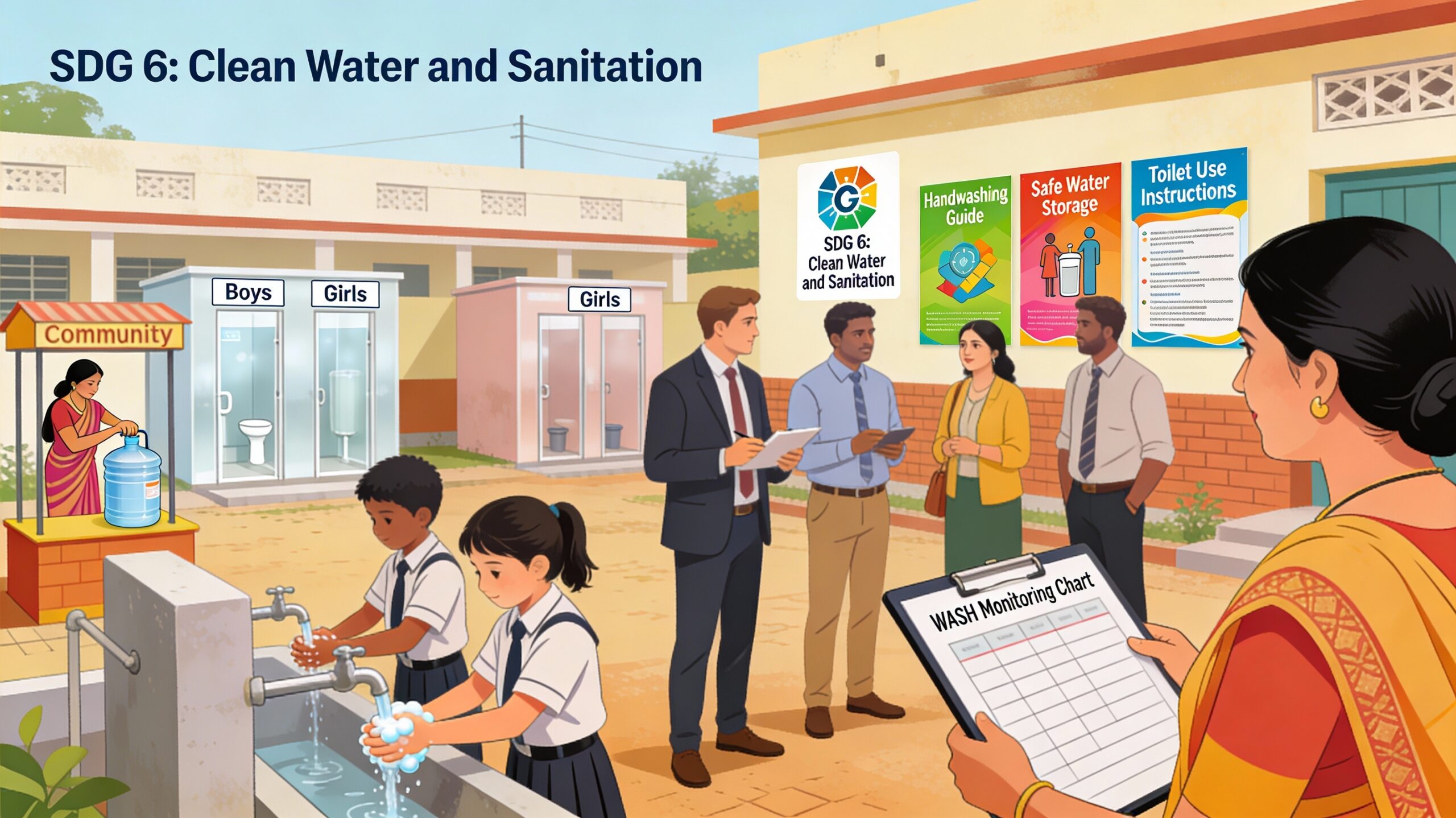
Why SDG 6 Is More Than Cleanliness
SDG 6, “Clean Water and Sanitation,” aims to ensure availability and sustainable management of water and sanitation for all. It covers safe and affordable drinking water (6.1), adequate sanitation and hygiene (6.2), water quality and wastewater treatment (6.3), water-use efficiency and scarcity (6.4), integrated water resources management (6.5), and protection of water-related ecosystems (6.6).
CSR in India has strongly embraced WASH—especially toilets in schools and villages—but employee engagement often stops at cleanliness drives, painting walls, or one-off hygiene campaigns. NGOs can redesign engagement so employees contribute to lasting improvements in water, sanitation, and hygiene systems, not just visible activities.
Shift The Lens: From Swachhata Events To WASH Systems
Many companies respond to SDG 6 by organising “Swachhta Saptah” weeks, toilet builds, or one-day clean-up drives around offices and schools. These can create visibility but may not ensure safe, sustainable WASH if they ignore behaviour change, operations and maintenance, or water availability.
An SDG 6–aligned approach asks:
- Is water actually safe to drink, and is there enough throughout the year?
- Are toilets functional, used, and maintained with dignity for women, girls, and persons with disabilities?
- Are communities and institutions able to manage WASH services over time?
Employee engagement can be designed to support assessment, behaviour change, and system strengthening, alongside infrastructure.
Step 1: Anchor The Program In SDG 6 Targets
Frame your employee engagement plan around SDG 6 targets that staff can realistically influence:
- 6.1 – Universal and equitable access to safe and affordable drinking water for all.
- 6.2 – Access to adequate and equitable sanitation and hygiene for all, ending open defecation, with special attention to women, girls, and vulnerable groups.
- 6.3 – Improving water quality, wastewater treatment, and safe reuse.
- 6.4 – Increasing water-use efficiency and addressing water scarcity.
Position employee engagement primarily under 6.2 and 6.4 (hygiene behaviour and water-use efficiency), with supportive roles for 6.1 and 6.3 through awareness, basic assessments, and advocacy.
Step 2: Map WASH Realities And Employee Levers
Before designing formats, NGOs should map:
- Workplace WASH: drinking water quality, toilets, handwashing stations, menstrual hygiene facilities, wastewater handling in offices, plants, and campuses.
- Community WASH: partner schools, communities, or factories’ access to safe water, sanitation, and hygiene; reliability, gender safety, and inclusion aspects.
- Employee levers: behaviour at work, internal WASH committees, support for school or community WASH clubs, and skills relevant to data, communication, or operations.
This ensures engagement is anchored in real SDG 6 gaps rather than generic cleanliness messaging.
Step 3: Design A WASH Engagement Journey
An SDG 6 employee program can be structured as a journey from awareness to co-ownership:
- Phase 1 – WASH and SDG 6 literacy: sessions on safe water, sanitation, hygiene, and gender dimensions.
- Phase 2 – Workplace WASH and water-use improvements: audits and behaviour-change campaigns in offices and plants.
- Phase 3 – Community/school WASH support: structured volunteering on hygiene education, monitoring, and operations and maintenance.
- Phase 4 – Data, advocacy, and ecosystem work: feeding evidence into local institutions and company policies.
This reflects SDG 6’s emphasis on sustainable management, not just infrastructure.
High-Impact SDG 6 Employee Engagement Formats
- WASH Literacy Labs And “Water Walks”
Start with WASH literacy labs explaining how unsafe water and poor sanitation drive disease, missed work/school days, and gender-based vulnerabilities. Use local examples of water scarcity, contamination, or overloaded sanitation facilities to make SDG 6 tangible.
Complement this with “water walks” in offices or communities where employees trace water’s journey: from source to tap, toilet to treatment or drain, identifying risks and gaps in quality, access, safety, and maintenance.
- Workplace Water And Sanitation Audits
Employees can help assess and improve WASH in their own workplaces as a first step. With NGO guidance, teams can:
- Check availability and functioning of toilets, handwashing points, and drinking water stations, with attention to accessibility and gender sensitivity.
- Observe hygiene behaviour patterns: handwashing with soap, use of toilets vs open areas, cleaning routines.
- Identify water-wasting behaviours and simple efficiency opportunities (leak fixes, tap aerators, reuse where safe).
Findings feed into action plans with facilities and HR, improving staff well-being and modelling SDG 6 inside the company.
- School And Community Hygiene Facilitation
For many CSR partners, SDG 6 work focuses on schools and communities. Employee engagement can include:
- Supporting school WASH clubs in designing handwashing and toilet-use campaigns using games, murals, and peer education.
- Co-facilitating sessions on menstrual hygiene, safe water storage, and latrine use with NGO staff—especially in settings where adult-led lectures are ineffective.
- Helping track simple WASH indicators (functioning toilets, soap availability, safe drinking water points) through child-friendly tools.
This strengthens behaviour-change components that are often under-resourced despite being critical for SDG 6.2.
- Water-Use Efficiency And Conservation Campaigns
Employees can contribute to SDG 6.4 by promoting water-use efficiency at work and, carefully, in communities. Activities might include:
- Office and plant water-use mapping, identifying high-use processes and potential efficiency measures (with technical partners).
- Employee-led campaigns on turning off taps, fixing leaks quickly, and reusing greywater where safe (gardens, cleaning).
- Basic water-saving education in partner communities and schools, using demonstrations and simple tools like low-cost flow restrictors.
NGOs should ensure that technical changes are vetted to avoid unintended health risks.
- Data, Monitoring, And Local Governance Support
SDG 6 also emphasises community participation and integrated water management (targets 6.5 and 6.B). Employees with data, IT, or communication skills can:
- Help design and maintain simple WASH monitoring tools (e.g., dashboards, paper or mobile forms) for schools and communities.
- Support local committees in summarising WASH data and presenting it to panchayats, school management committees, or ward offices.
This connects employee engagement to governance, not only service delivery.
Step 4: Governance, Safeguards, And Dignity
WASH work touches privacy, gender norms, and health; safeguards are essential. NGOs should:
- Ensure volunteers respect privacy in toilets and bathing areas; no photography in sensitive spaces.
- Train employees on cultural norms, gender-sensitive communication, and child protection before any field engagement.
- Clarify that frontline promotion and technical design remain with trained WASH staff; employees support but do not replace professional roles.
A joint steering group (CSR, HR, facilities, NGO, local partners) can oversee design, risk, and grievance mechanisms.
Step 5: Metrics That Reflect WASH Outcomes
Move beyond counting toilets built or volunteers involved by tracking SDG 6–aligned indicators such as:
- Number of people with improved access to safe drinking water and sanitation facilities (and whether they are functional and used).
- Hygiene behaviour change indicators: frequency of handwashing with soap, reduction in open defecation, use of school or community toilets.
- Water-use efficiency metrics: reductions in consumption per employee or per unit of output where data is available.
- Functionality and maintenance status of WASH infrastructure over time, not just at inauguration.
Align these with SDG 6 targets (6.1, 6.2, 6.3, 6.4) to strengthen CSR and ESG reporting.
Step 6: Storytelling That Respects People And Complexity
WASH stories can easily become “before/after toilet” narratives that overlook complex realities. NGOs can help shape communication so that:
- People are shown with dignity and agency, not as passive beneficiaries.
- Challenges of maintenance, behaviour change, and water scarcity are acknowledged, not glossed over.
- Stories explain how employee engagement contributed to system improvements (monitoring, awareness, governance) rather than claiming sole credit.
This builds more honest, mature narratives around SDG 6 and strengthens trust with communities.
Written by Deb who is a social impact worker and part of letzrise team and stays in Bengaluru.