

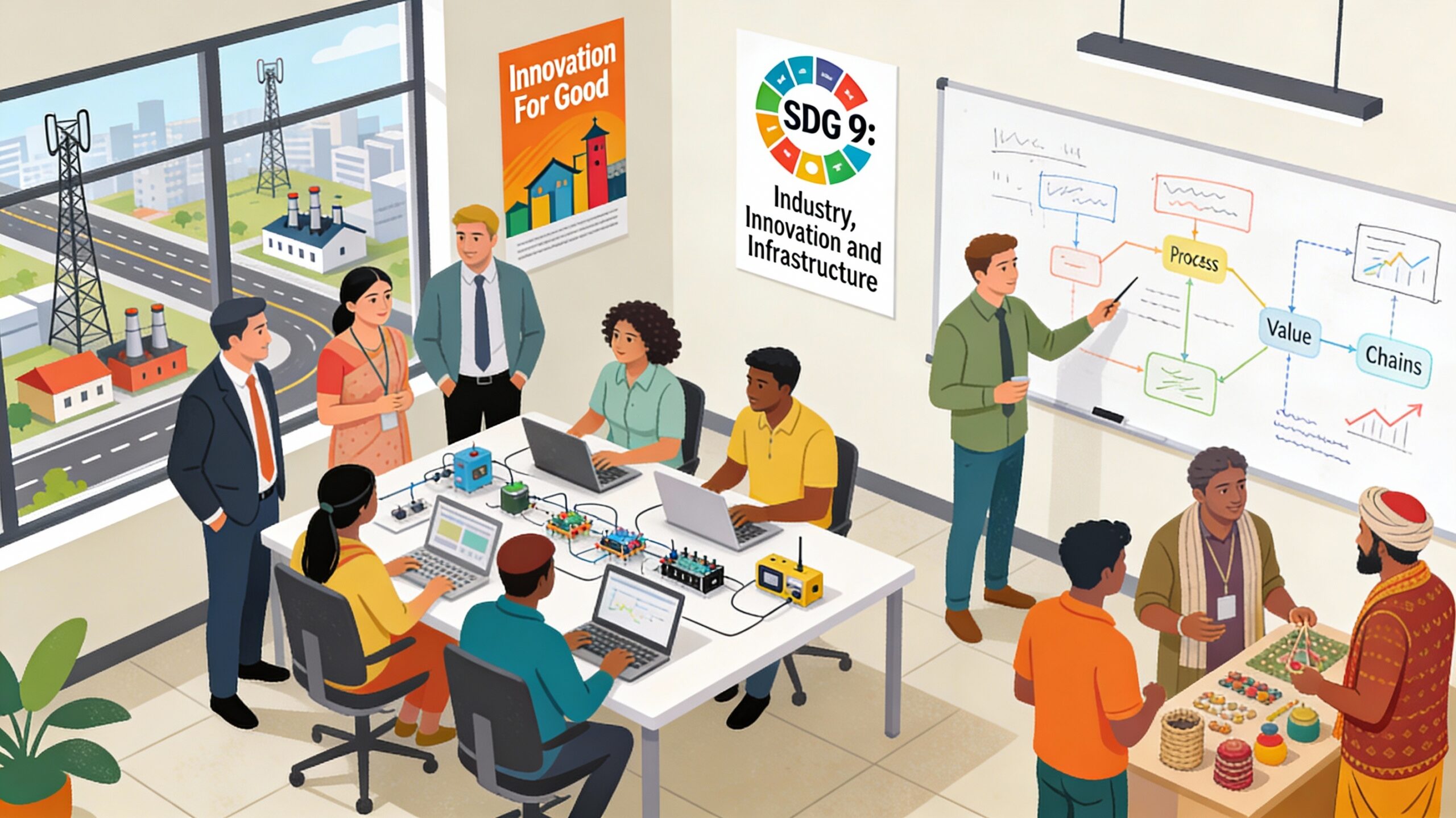
Why SDG 9 Fits Naturally With Corporate Employee Engagement
SDG 9, “Industry, Innovation and Infrastructure,” focuses on building resilient infrastructure, promoting inclusive and sustainable industrialization, and fostering innovation. It includes targets on quality infrastructure (9.1), inclusive industrial growth (9.2), access to finance and technology for small enterprises (9.3), upgrading industries for resource efficiency (9.4), and strengthening research, technology, and internet access (9.5–9.c).
Most companies already see themselves as innovation- and infrastructure-driven; the gap is connecting this strength to social needs and SDG 9 outcomes. NGOs are well placed to turn employee engagement into structured “tech and innovation for good” programs that link corporate capabilities with real development challenges.
Shift The Lens: From CSR Donations To Co-Creating Solutions
CSR for SDG 9 often stops at funding labs, incubators, or equipment for ITIs and colleges. While useful, this misses a huge opportunity: engaging employees as mentors, problem-solvers, and co-designers of inclusive, sustainable infrastructure and technologies.
An SDG 9–aligned approach treats employees as innovation partners with communities and local enterprises, not just donors or judges at pitch events. Engagement should move from cheque-writing and one-day hackathons to multi-step journeys where teams understand field problems, co-create solutions, and support implementation.
Step 1: Anchor The Program In SDG 9 Targets
Start by framing your proposal around a few SDG 9 targets that employee engagement can realistically touch:
- 9.1 – Develop quality, reliable, sustainable and resilient infrastructure to support economic development and human well-being.
- 9.2 – Promote inclusive and sustainable industrialization and raise industry’s share of employment and GDP.
- 9.3 – Increase access of small-scale industries and other enterprises to financial services and integration into value chains and markets.
- 9.5 & 9.b – Enhance scientific research and support domestic technology development and innovation.
Position employee engagement as contributing to 9.3, 9.5 and 9.b (innovation support, skills, and markets for local enterprises), with indirect contributions to 9.1 and 9.4 via better-designed, more sustainable projects.
Step 2: Map Local Innovation And Infrastructure Gaps
With the CSR partner, map three things:
- Local infrastructure and access gaps: connectivity, logistics, water/energy reliability, digital access, or public-service bottlenecks relevant to your theme.
- Existing innovators and small enterprises: start-ups, social enterprises, producer groups, artisans, youth innovators, rural labs, or incubation centres.
- Employee capabilities: engineering, product, IT, data, design, finance, operations, supply chain, legal, marketing—skills that can support SDG 9 goals.
This mapping ensures your employee engagement formats are grounded in real innovation ecosystems, not abstract “tech-for-good” rhetoric.
Step 3: Design An SDG 9 Innovation Journey For Employees
Instead of standalone hackathons, design a multi-stage journey:
- Phase 1 – Field immersion and problem-definition: employees learn directly from communities, MSMEs, and frontline staff about infrastructure and process bottlenecks.
- Phase 2 – Co-creation and prototyping: mixed teams (employees + NGOs + local innovators) develop and test low-cost prototypes or process improvements.
- Phase 3 – Piloting and mentoring: selected ideas are piloted with CSR support; employees act as mentors or project owners.
- Phase 4 – Integration and scale: promising solutions link to company capabilities, market access, or larger government schemes where appropriate.
This approach reflects SDG 9’s emphasis on innovation, inclusive industrialization, and resilient infrastructure.
High-Impact SDG 9 Employee Engagement Formats
- “Problem Discovery” Labs With MSMEs And Communities
Start with problem discovery, not solutions. NGOs can convene sessions where:
- Local MSMEs, artisans, farmers, or community groups share practical bottlenecks (e.g., storage, transport, quality control, digital access, payment delays).
- Employees listen, map root causes, and cluster problems into themes (infrastructure, process, technology, market linkages).
This builds respect, context, and a backlog of real SDG 9 challenges to work on, instead of hypothetical use cases.
- Tech-For-Good And Process-For-Good Sprints
Based on identified challenges, run sprints where cross-functional employee teams co-create solutions with NGOs and local partners:
- Tech-for-good: simple apps, dashboards, sensor-based alerts, or workflow tools tailored to local constraints.
- Process-for-good: redesigned production flows, quality checks, packaging, or logistics that cut waste and improve reliability.
Keep prototypes low-cost and appropriate; focus on usability and ownership rather than flashy features.
- Skills-Based Support To Local Enterprises And Makers
Employees can provide targeted skills to small enterprises and innovation hubs:
- Finance and business planning, unit economics, costing, compliance.
- Product design and user research.
- Marketing, branding, digital presence, and e-commerce.
This directly supports SDG 9.3 by helping small enterprises access markets and financial services more effectively.
- Infrastructure And Process Improvement In NGO And Public Systems
SDG 9 is also about upgrading infrastructure and processes to be more efficient and sustainable. Employees can:
- Help NGOs or public institutions streamline data systems, asset maintenance, inventory, or service workflows.
- Support basic digitalisation of records and monitoring systems.
This strengthens the “soft infrastructure” behind social programs, improving reliability and scale.
- Innovation Showcases And Learning Loops
Close each cycle with showcases where teams present prototypes, learnings, and honest failures. Invite community partners, local government, incubators, and leadership to participate as co-learners, not just judges.
Document learnings in simple case notes: what worked, what didn’t, what to try next. This builds an internal culture of experimentation tied to SDG 9 rather than one-off competitions.
Step 4: Governance, Ethics, And Sustainability
Innovation work can easily slip into extractive or “pilotitis” behaviour. To prevent this:
- Clarify ownership and IP in advance, prioritising community and local enterprise benefits.
- Avoid testing half-baked solutions that could harm livelihoods or create dependency without a sustainability plan.
- Set criteria for when the company will and will not support scaling (alignment with core business, values, and SDG impact).
A joint steering group (CSR, business units, NGO, local partners) should oversee project selection, risk, and follow-through.
Step 5: Metrics That Capture Innovation And Inclusion
Move beyond counting hackathons and volunteers by tracking:
- Number and diversity of problems documented from the field.
- Prototypes developed and piloted, with basic outcome metrics (time saved, cost reduced, reliability improved, people reached).
- MSMEs/enterprises supported, and improvements in revenue, access to markets, or process efficiency where measurable.
- Internal shifts: employees engaged in SDG 9 projects, innovation culture indicators, and cross-functional collaboration.
Tie these metrics to SDG 9 targets (especially 9.3, 9.4, 9.5, 9.b) in CSR and sustainability reporting.
Step 6: Storytelling That Highlights Co-Creation And Local Talent
Stories around SDG 9 often celebrate technology alone; NGOs can help reframe them to spotlight relationships and local ingenuity:
- Elevate stories of youth, artisans, or small entrepreneurs who co-created solutions, with employees in supporting roles.
- Explain clearly how each project ties to SDG 9 targets—e.g., “helped a cluster of women entrepreneurs access digital markets” (9.3), or “simplified rural inventory tracking” (9.1/9.4)
This builds pride in cross-sector collaboration and positions the company as a responsible innovation partner.
Written by Deb who is a social impact worker and part of letzrise team and stays in Bengaluru.