

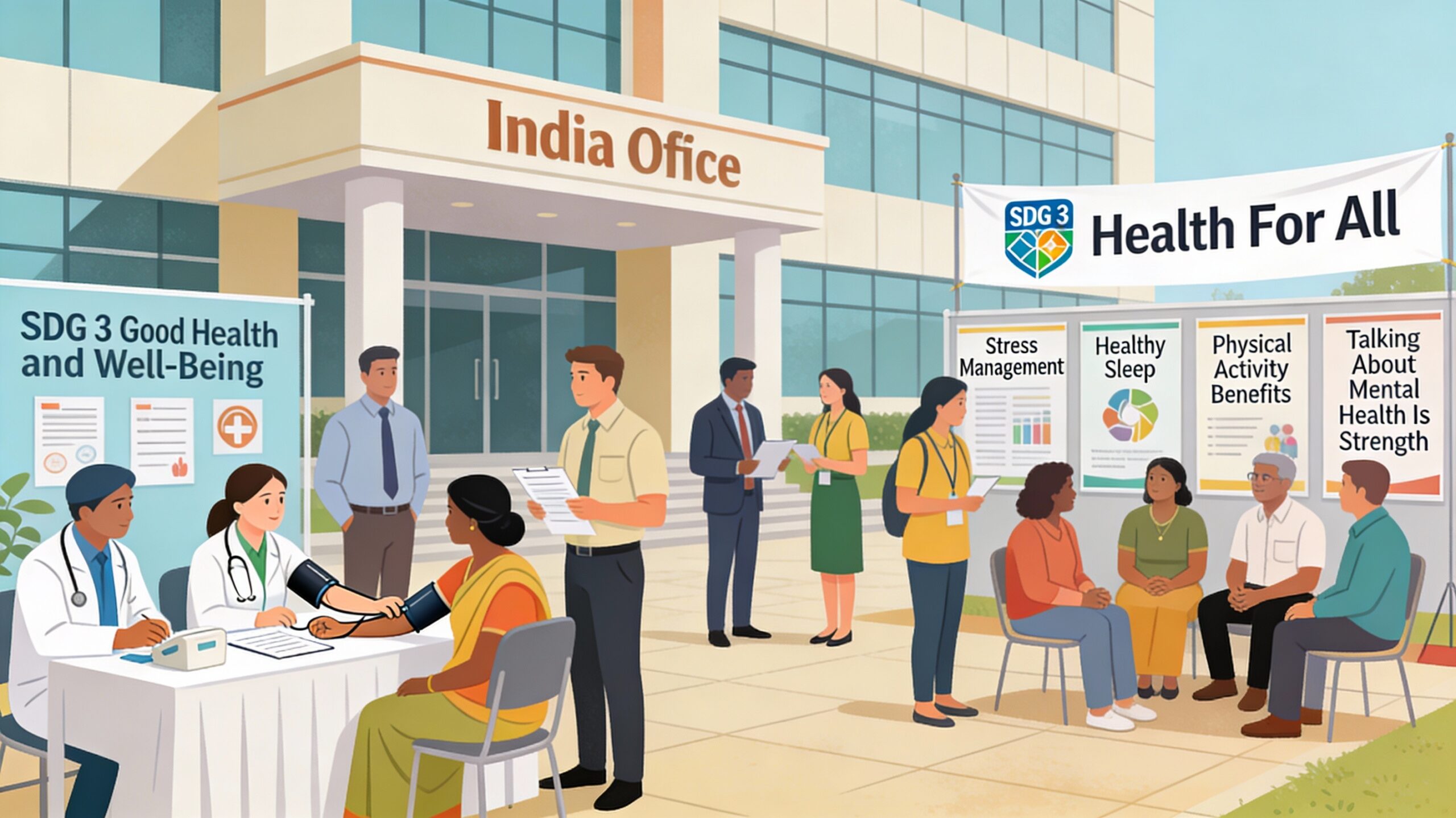
Why SDG 3 Is A Strategic Space For Employee Engagement!
SDG 3, “Good Health and Well-Being,” aims to ensure healthy lives and promote well-being for all at all ages. It includes targets on maternal and child health, infectious and noncommunicable diseases, mental health, substance abuse, road safety, sexual and reproductive health, universal health coverage, and pollution-related illnesses.
Most CSR-health efforts in India focus on health camps, hospital tie-ups, and one-off awareness days. NGOs can help redesign SDG 3 employee engagement so that staff strengthen prevention, mental health, and community health systems—linking workplace well-being with surrounding communities instead of treating them as separate worlds.
Shift The Lens: From Health Camps To Prevention, Care, And Voice
Health camps and one-day drives can be useful entry points but often do little to change long-term health behaviours, access, or systems. SDG 3 calls for reducing premature mortality from noncommunicable diseases, ending epidemics, improving mental health, and achieving universal health coverage.
An SDG 3–aligned approach asks:
- Are employees and community members able to prevent illness and access care early?
- Do mental health, stress, and gendered health burdens get addressed, or ignored?
- Are environmental and workplace health risks being reduced over time?
Employee engagement can be designed so staff become advocates and co-creators of healthier workplaces and neighbourhoods, not just participants in events.
Step 1: Anchor Engagement In SDG 3 Targets
Prioritise SDG 3 targets where employee engagement has real leverage:
- 3.4 – Reduce premature mortality from noncommunicable diseases (NCDs) and promote mental health and well-being.
- 3.5 – Strengthen prevention and treatment of substance abuse.
- 3.7 – Ensure universal access to sexual and reproductive health care, information, and education.
- 3.8 – Achieve universal health coverage, including financial risk protection and access to essential services.
- 3.9 – Reduce deaths and illnesses from hazardous chemicals and air, water, and soil pollution.
Position employee engagement primarily under 3.4, 3.7, 3.8, and 3.9 through workplace and community health literacy, behaviour change, and system navigation support.
Step 2: Map Health Risks, Systems, And Employee Skills
With CSR, HR, and health partners, map:
- Workplace health profile: common NCD risks (stress, inactivity, diet, tobacco), mental-health concerns, occupational hazards, and current wellness offerings.
- Community health realities: maternal and child health, vaccination, infectious disease, nutrition, road safety, environmental risks, and health-system gaps around the company’s locations.
- Employee skills and interest: health professionals, first-aid/peer support volunteers, communication and digital skills, lived experience with certain conditions, and willingness to engage.
This ensures engagement is targeted and complements existing public health and CSR programs.
Step 3: Design A Health And Well-Being Journey
A structured SDG 3 employee program can be framed as a journey:
- Phase 1 – Health literacy and destigmatisation: understanding SDG 3, common risks, and rights-based health approaches.
- Phase 2 – Workplace health actions: peer-support networks, healthy habits, and safer work environments.
- Phase 3 – Community health engagement: supporting awareness, navigation, and simple follow-up around existing health services.
- Phase 4 – Advocacy and systems: feeding insights into policies, benefits, and local health planning.
This reflects SDG 3’s emphasis on prevention, equity, and systems, not one-time camps.
High-Impact SDG 3 Employee Engagement Formats
- SDG 3 And Health Literacy Labs
Start with sessions that explain SDG 3 targets in accessible language—NCDs, infectious diseases, mental health, sexual and reproductive health, and environmental risks. Include:
- Local data and stories on hypertension, diabetes, depression, and road injuries.
- Myth-busting on vaccines, mental health, and reproductive health.
- Orientation to public schemes (e.g., health insurance, immunisation, maternal-health initiatives) and how to access them.
These labs can be run for employees first, then adapted for community outreach in partnership with health workers.
- Peer Well-Being Champions And Mental Health Support
NCD and mental-health targets (3.4) are directly relevant at work. NGOs can help set up:
- Peer well-being champions trained to share basic health information, encourage screening, and signpost to professional services.
- Mental-health first-aid or gatekeeper programs, teaching employees to notice distress, listen non-judgmentally, and refer safely.
- Campaigns normalising use of counselling and EAPs, and addressing stigma around mental health and substance use.
This builds a supportive culture while keeping clinical roles with professionals.
- Targeted Screenings And Follow-Up, Not Just Camps
When health camps are appropriate, design them as part of a continuum:
- Focused screenings aligned with local needs (e.g., blood pressure, blood sugar, anaemia, vision) for employees and community members.
- Clear protocols for follow-up: referral pathways, reminder systems, and navigation support for those with positive findings.
- Data-sharing agreements and privacy safeguards, with aggregated insights feeding into CSR planning and local health-system dialogue.
This contributes to early detection and SDG 3.4 and 3.8 rather than one-off check-ups.
- Community Health Navigation And Behaviour Change
Employees can support SDG 3 by helping communities connect with existing services rather than creating parallel systems:
- Working with ASHAs/ANMs/NGOs to map local facilities, schemes, and outreach schedules.
- Co-facilitating small-group sessions on nutrition, hygiene, reproductive health, and road safety, using materials vetted by health partners.
- Helping families understand and use health insurance schemes or digital health platforms.
Employees act as amplifiers and navigators, while frontline health workers remain central.
- Health, Environment, And Safer Spaces
Target 3.9 links health to pollution and environmental hazards. Engagement can include:
- Workplace initiatives on air quality, ergonomics, and safe chemical use, co-designed with safety teams.
- Community projects that reduce health risks from waste burning, unsafe water, or traffic around schools and workplaces.
- Employee participation in local planning about parks, walkability, and road safety, connecting SDG 3 with SDG 11 and SDG 13.
This broadens health beyond clinical issues to everyday environments.
Step 4: Safeguards, Ethics, And Boundaries
Health work is sensitive and can cause harm if mishandled:
- Volunteers must not offer diagnosis or treatment; they should refer to qualified providers.
- Confidentiality, consent, and non-discrimination principles must guide all health-related activities.
- Special care is needed around topics like mental health, HIV, TB, sexual and reproductive health, and violence; facilitators need training and clear referral pathways.
A governance group (CSR, HR, health partners, NGOs) should review content, manage risks, and respond to issues raised.
Step 5: Metrics That Reflect Health And Well-Being
Go beyond counting camps, participants, or volunteer hours. Track SDG 3–aligned indicators such as:
- Number of people screened and proportion successfully linked to follow-up care.
- Changes in key risk factors (e.g., tobacco use, physical activity, blood-pressure control) where appropriate and ethical.
- Utilisation of mental-health and counselling services, and shifts in stigma-related attitudes.
- Community-level outcomes where possible (e.g., immunisation coverage, use of antenatal care, helmet/seat-belt use, reduced hazardous practices).
Align these with SDG 3 indicators (especially 3.4, 3.7, 3.8, 3.9) and national health priorities.
Step 6: Storytelling That Respects Privacy And Complexity
Health stories must protect dignity and confidentiality:
- Avoid sharing identifiable details of individuals’ health conditions without explicit, informed consent.
- Focus on structural improvements (better access, safer workplaces, stronger linkages to care) rather than “cured by our camp” narratives.
- Highlight collaboration with health systems and communities, and the role of employees as supporters, not saviours.
This builds trust and reinforces a rights-based view of SDG 3.
Written by Deb who is a social impact worker and part of letzrise team and stays in Bengaluru.