

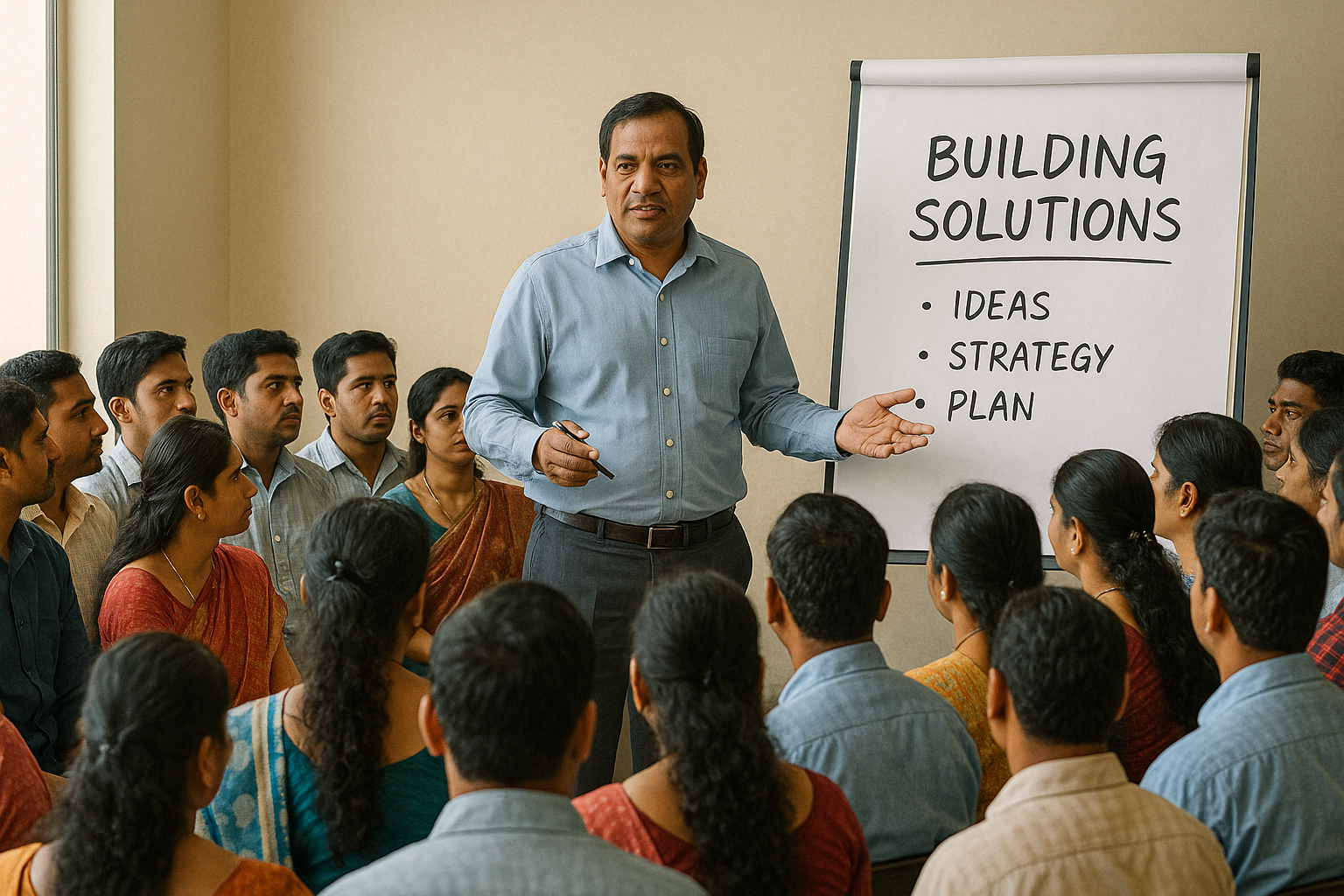
From Insight to Impact: Hope Givers Module 4 — Building Solutions
In Module 4 of our journey with the Hope Givers team, we shifted from powerful storytelling to purposeful solution-building. With a foundation established in earlier modules—stories fueled by heart, clarity, and vision—this session focused on shaping those narratives into tangible, scalable solutions that respond to real-world challenges.
What We Explored
- From Story to Strategy– We began by revisiting the stories crafted in Module 3, extracting core themes and challenges they illuminated. Teams then learned how to translate narrative arcs into solution frameworks—identifying problem statements, defining target beneficiaries, and sketching out clear outcomes.
- Design Thinking in Action– Participants immersed themselves in the core phases of design thinking:
- Empathize & Define: Understanding end-user pain points.
- Ideate: Rapid brainstorming without limits.
- Prototype: Sketching rough models—be they service flows, pilot programs, or mockups.
- Test & Iterate: Gathering early feedback to refine.
This hands-on approach fostered creativity while grounding ideas in practical feasibility.
- Setting Realistic Outcomes– With Letzrise facilitators guiding the way, teams learned to articulate SMART goals—Specific, Measurable, Achievable, Relevant, Time-bound. Clarity around objectives like “reach 100 underserved students in 6 months” became the anchor for every innovation.
- Collaborative Feedback Loops– Teams paired up to pitch their solution frameworks and received structured peer feedback. Observations centered on impact potential, feasibility, and alignment with organizational mission. This collaborative energy sparked refinements and deeper strategic clarity.
- Tools for Transformative Execution– We introduced practical scaffolds to support solution-building:
- Logic Models: Visual mapping from inputs and activities to outputs and outcomes.
- Lean Canvases: Quick, one-page plans to articulate problem, solution, metrics, and cost structure.
- Risk Matrices: Identifying what could go wrong—and planning accordingly.
These tools provided Hope Givers with clear, ready-to-use templates for post-workshop implementation.
Key Takeaways
- Stories are catalysts, solutions are vehicles: While storytelling fuels purpose, structured solution-building ensures sustainable impact.
- Prototype rapidly, refine continuously: The first idea might not stick—but every iteration moves us closer.
- Measure what matters: Outcomes grounded in clarity boost both funder confidence and mission-driven momentum.
- Community sharpens your vision: Peer critique and collective insights are powerful accelerators of innovation.
What’s Coming Next?
As Module 4 concluded, the Hope Givers team is now equipped with actionable frameworks and strategic clarity. With the skills to frame a hook (from Module 2), highlight challenges (from Module 3), and now present solutions in their stories, they are ready to move forward to the next step—learning how to integrate impact into storytelling in Module 5.
This blog is authored by Deb who is a seasoned fundraiser and a core member of the Letzrise team, bringing deep expertise in mobilizing resources and building sustainable funding pathways for social impact organizations.