

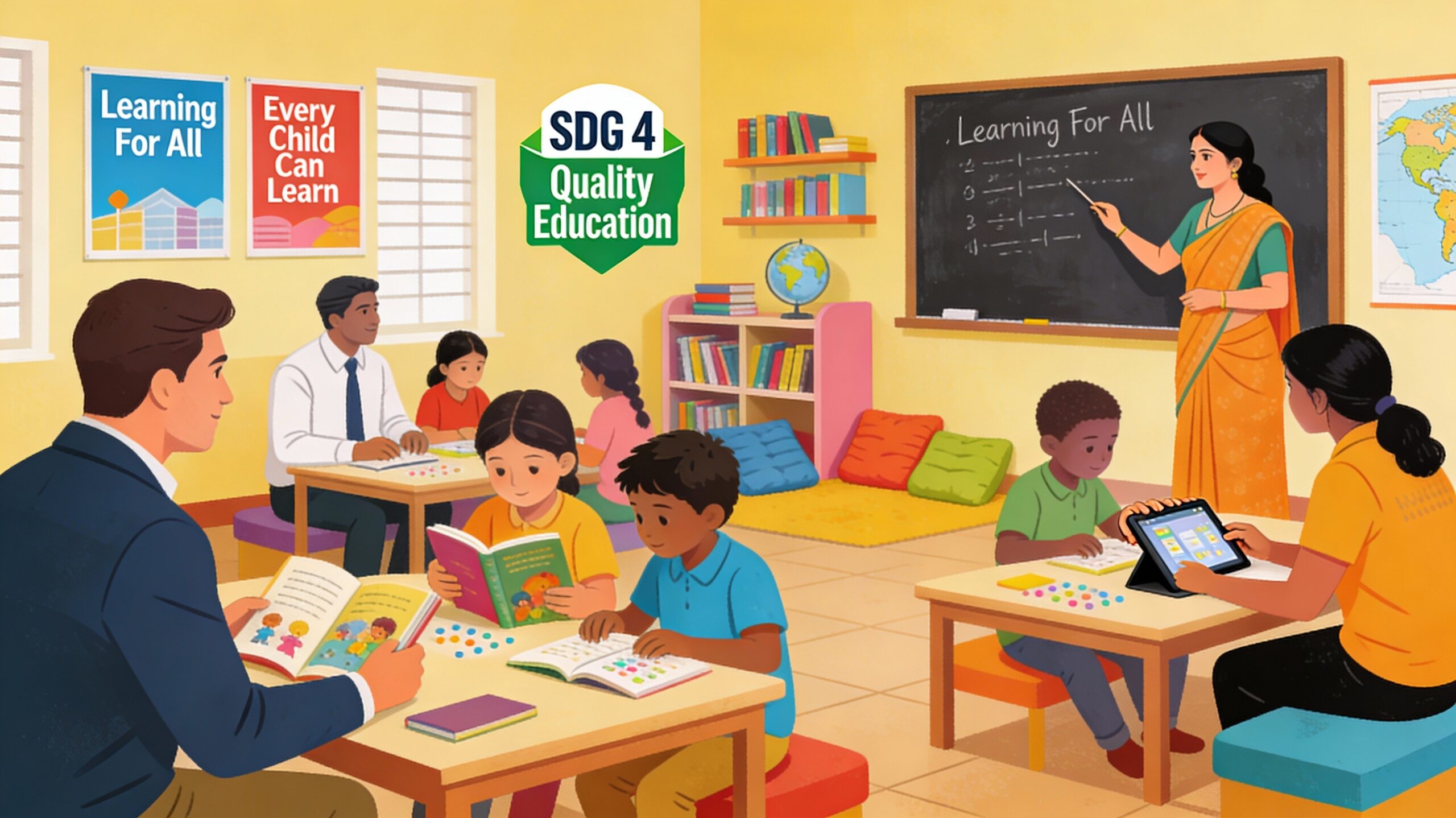
Why SDG 4 Is A Natural Home for Employee Volunteering!
Happy Republic Day , On this day let see how SDG 4, “Quality Education,” aims to ensure inclusive and equitable quality education and promote lifelong learning opportunities for all. It covers free, quality primary and secondary education (4.1), early childhood development (4.2), technical and vocational education (4.3, 4.4), elimination of discrimination in education (4.5), universal literacy and numeracy (4.6), and education for sustainable development and global citizenship (4.7).
Education-themed CSR is widespread in India, and many companies ask employees to “teach for a day” or run ad-hoc sessions in schools and NGOs. However, without structure or continuity, such efforts can disrupt classrooms more than they help teachers and students. NGOs can redesign SDG 4 employee engagement so that staff strengthen learning ecosystems instead of doing stand-alone activities.
Shift The Lens: From Guest Lectures To Learning Support Systems
“Feel-good” education volunteering often centres on one-time English or motivation classes, distribution drives, or photo-op visits. These can spark interest but do little to improve foundational skills, teacher capacity, or school systems that SDG 4 prioritises.
An SDG 4–aligned approach asks:
- Are children actually learning to read, write, and do basic math?
- Are classrooms safe, inclusive, and engaging for all, especially girls and children with disabilities?
- Are teachers and education NGOs supported, or overloaded by volunteers?
Employee engagement must therefore move from “teaching as an event” to structured support around literacy, numeracy, life skills, and system strengthening.
Step 1: Anchor Engagement In SDG 4 Targets
Frame your program around SDG 4 targets where employees can add real value:
- 4.1 – Free, equitable, quality primary and secondary education leading to effective learning outcomes.
- 4.4 – Skills for employment, decent jobs, and entrepreneurship.
- 4.5 – Eliminate gender and other disparities in education and ensure access for vulnerable children.
- 4.7 – Education for sustainable development, human rights, gender equality, and global citizenship.
Position employee engagement as primarily supporting 4.1, 4.4, and 4.7 through classroom and after-school support, mentoring, and skills sessions, while being careful not to replace trained teachers.
Step 2: Map Learning Gaps, Stakeholders, And Employee Skills
Before creating formats, work with schools/NGOs and CSR teams to map:
- Learning levels: basic data on reading and math for different grades; which students are falling behind.
- School and NGO constraints: teacher–student ratios, time for remedial support, infrastructure, and inclusion gaps (girls, children with disabilities, first-generation learners).
- Employee skills: languages, comfort with children, content knowledge, facilitation, digital and career skills for older students, plus ability to commit time regularly.
This mapping keeps engagement realistic and aligned with SDG 4 priorities rather than generic teaching.
Step 3: Design A Tiered Education Engagement Journey
A robust SDG 4 program can be built as a tiered journey:
- Tier 1 – Exposure and sensitisation: learning about SDG 4, local education challenges, and pedagogy basics.
- Tier 2 – Classroom and remedial support: structured, supervised sessions for foundational skills with clear lesson plans.
- Tier 3 – Mentoring and skills-building: career and life-skills support for adolescents and youth.
- Tier 4 – System support: skills-based volunteering for school/NGO systems (data, content, tech).
This respects the central role of educators while harnessing employee strengths.
High-Impact SDG 4 Employee Engagement Formats
- SDG 4 Literacy And Pedagogy Orientation
Start by helping employees understand SDG 4 targets, local enrolment and learning-outcome gaps, and why pedagogy matters. Brief, practical orientation should cover:
- How children learn to read and do math; why worksheets alone are not enough.
- Child protection, safeguarding, and inclusive practices.
- The role of the teacher vs the volunteer.
This prevents well-intentioned but disruptive classroom behaviour.
- Structured Reading And Math Support Sessions
Under teacher/NGO guidance, employees can support foundational learning by:
- Running small-group reading circles using levelled books and phonics or language activities.
- Supporting math games and practice for basic operations and problem-solving.
- Using simple digital tools (where available) for practice and tracking progress.
Sessions must be aligned with the school’s or NGO’s pedagogy, with clear groupings, goals, and monitoring, not ad-hoc “fun classes.”
- Life Skills, Career Exposure, And Mentoring For Older Students
For adolescents and youth, employee engagement can focus on SDG 4.4 (skills for work and entrepreneurship):
- Career talks anchored in reality: pathways after class 10/12, vocational options, and non-linear journeys.
- Life skills sessions on communication, problem-solving, teamwork, and digital citizenship.
- One-on-one or small-group mentoring cycles for students at key transition points (e.g., post-10th, college entry, first job).
This supports smooth transitions and reduces dropout driven by confusion or lack of guidance.
- Skills-Based Support To Schools And Education NGOs
SDG 4 also requires system improvements—data, infrastructure, teacher support. Employees can contribute by:
- Helping NGOs build or improve simple data and MIS systems for tracking enrolment, attendance, and learning outcomes.
- Designing or localising teaching and learning materials (TLMs), digital content, or simple assessments under educator guidance.
- Supporting school management committees or education collectives with communication materials and documentation.
This frees educator time to focus on teaching and learner support.
- Global Citizenship And Thematic Learning Projects
Target 4.7 focuses on education for sustainable development, human rights, and global citizenship. Employees can co-facilitate project-based learning modules, for example:
- Climate and environment: school or community projects on waste, water, or energy.
- Rights and responsibilities: age-appropriate activities on equality, inclusion, and digital safety.
These projects show students how classroom learning connects to real-world issues and other SDGs.
Step 4: Safeguards, Roles, And Ethics
Work with children demands strong safeguards:
- Clear child-protection policies, background checks where required, and strict no-one-on-one private sessions without supervision.
- Consent and coordination with school management; volunteers should never disrupt core teaching time without planning.
- Respect for teacher expertise; volunteers support, they do not evaluate or override teachers.
A joint governance committee (NGO, school, CSR, HR) should oversee the program and handle any concerns.
Step 5: Metrics That Reflect Learning, Not Just Hours
SDG 4 progress must be measured in learning and inclusion, not just activities. Possible indicators:
- Number of students receiving regular small-group support and changes in basic reading and math proficiency over time.
- Attendance and retention improvements in target schools/groups.
- Number of adolescents receiving mentoring or career guidance, and their transition outcomes (continued education, vocational training, employment).
- System improvements: better data use, TLMs created, or teacher satisfaction with volunteer support.
Where feasible, align with SDG 4 indicators and national learning metrics (e.g., basic literacy benchmarks).
Step 6: Storytelling That Honors Learners And Teachers
Education stories often focus on volunteers “transforming” students. SDG 4–aligned storytelling should:
- Centre children’s and teachers’ agency and hard work.
- Acknowledge structural barriers (poverty, discrimination, disability, conflict) that require more than volunteerism.
- Show how employee engagement supports and amplifies educator-led efforts, instead of overshadowing them.
This builds respect and long-term trust between corporates, NGOs, schools, and communities.
Written by Deb who is a social impact worker and part of letzrise team and stays in Bengaluru.