

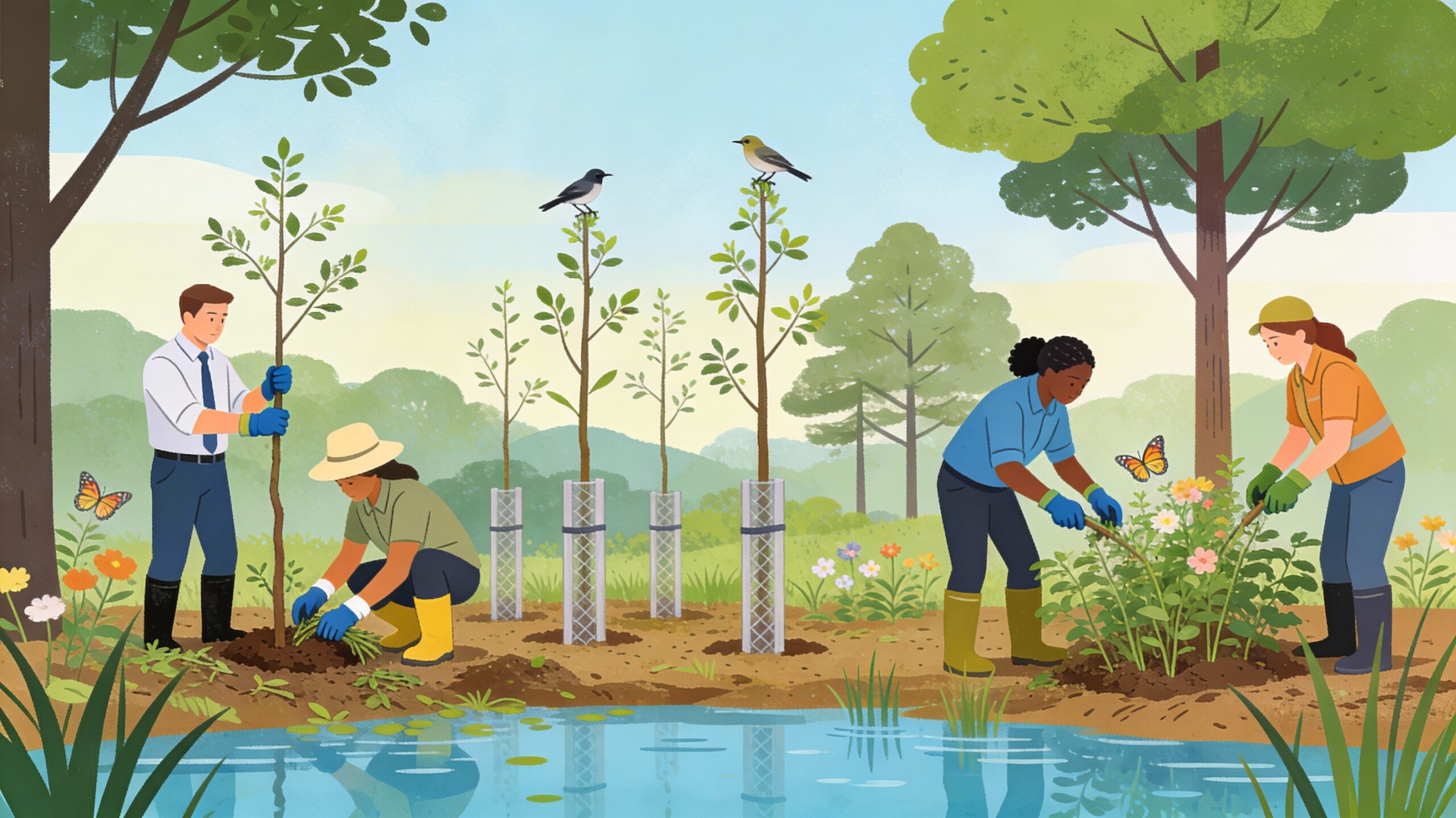
Corporate CSR for the environment is moving beyond symbolic tree-planting days to long-term ecosystem restoration, where employees act as stewards, not just volunteers. For NGOs, this opens a powerful space to design engagements that combine fieldwork, citizen science, and skills-based volunteering across afforestation and habitat restoration themes.
Why afforestation CSR needs deeper engagement
Many CSR programmes still focus on one-day plantation drives that look good in photos but often ignore survival, species choice, and community ownership. Without long-term care and meaningful employee involvement, these efforts risk becoming “greenwashing” rather than genuine climate and biodiversity solutions.
- Well-designed programmes shift the focus from number of saplings planted to survival, canopy development, biodiversity, and community benefits.
- Corporate employees can become long-term champions for local ecosystems when given structured roles beyond the initial planting event.
Field-based activities beyond photo-op plantations
- Ecologically sound plantation days
Plantation drives can be powerful when rooted in ecology, not optics. NGOs can turn “CSR tree days” into immersive learning and action experiences.
- Use degraded urban or rural sites and prioritise native, climate-resilient species suited to local soil and rainfall conditions.
- Combine planting with short, interactive sessions on local ecology, water cycles, wildlife, and how planted trees will support broader habitat restoration.
- Habitat restoration camps
Afforestation is only one part of restoring ecosystems; employees can support broader habitat work. NGOs can organise focused restoration camps in forests, wetlands, mangroves, or urban biodiversity parks.
- Activities can include invasive species removal, mulching, contour bunding, check dams, and enrichment planting under existing tree cover.
- Add guided walks that show “before–after” changes and explain how these interventions help soil health, water retention, and biodiversity.
- Clean-up and rejuvenation of lakes, rivers, and urban habitats
Waterbodies and urban green spaces are critical habitats that corporates increasingly want to support. NGOs can design employee engagement around restoration of these interfaces.
- Conduct structured clean-up drives along lakes, rivers, and wetlands, combined with waste segregation, simple water observations, and basic biodiversity checks.
- Link these activities to longer restoration plans, such as riparian planting, reed-bed creation, and community awareness campaigns.
Data, technology, and citizen science engagement
- Tree and habitat monitoring via digital tools
The real impact of afforestation is visible months and years later, which is why long-term monitoring is essential. This is a strong area for ongoing employee engagement.
- Build simple protocols or use existing apps for employees to record tree survival, growth, canopy spread, and evidence of birds or insects during periodic visits.
- Corporate teams can “adopt” plots and receive dashboards on survival rates, estimated carbon sequestration, and biodiversity sightings.
- Biodiversity walks and citizen science “bio-blitz” events
Citizen science turns employees into data collectors for conservation. NGOs can design half- or full-day events focused on biodiversity.
- Train employees to document birds, butterflies, plants, or amphibians using citizen science platforms during guided walks.
- Use the collected data to track habitat health and advocate for protection or improved management of local ecosystems.
- GIS, mapping, and analytics support
For corporates with tech or analytics strength, skills-based volunteering can directly support landscape planning. NGOs can create structured projects that utilise these capabilities.
- Engage employees in mapping planted areas, habitat patches, and corridors using GIS tools and satellite imagery.
- Build simple spatial dashboards to visualise where trees are thriving, where gaps exist, and how restored areas connect to wildlife habitats.
Awareness, culture, and green leadership inside companies
- Green challenges linked to on-ground restoration
Behaviour change inside offices can be tied back to external habitat outcomes. NGOs can co-design “green challenge” campaigns with CSR and HR teams.
- Run month-long challenges on waste reduction, energy saving, and low-carbon commuting, with progress tracked team-wise.
- Convert collective achievements into tangible restoration actions, such as funding maintenance of specific forest plots or wetland interventions.
- Environmental education and storytelling sessions
Employees engage more deeply when they understand the stories behind the landscapes.
- Host talks or webinars on local forests, grasslands, mangroves, or wetlands, including how climate change and development pressures affect them.
- Invite community members, forest-dependent families, or frontline conservation workers to share lived experiences and link them to upcoming field activities.
- Employee “green champion” networks
Long-term success depends on internal champions who keep the agenda alive. NGOs can support companies to build and mentor such networks.
- Identify and train green champions across locations to coordinate plantation care, restoration follow-ups, and internal campaigns.
- Provide simple toolkits—checklists, session plans, monitoring templates—so champions can run micro-initiatives with minimal external support.
Designing and pitching impactful programmes as an NGO
To convert ideas into funded, sustained CSR partnerships, NGOs need to design with both ecology and corporate needs in mind.
- Plan for maintenance, not just planting
- Clearly budget and plan for 3–5 years of care: watering, mulching, replacing dead saplings, and protecting sites from grazing or encroachment.
- Highlight survival, canopy, and biodiversity metrics rather than only gross planting numbers to show serious intent.
- Co-create metrics and communication
- Define joint KPIs: trees surviving, hectares restored, species recorded, volunteer hours, and approximate carbon and water benefits.
- Share regular updates through photos, short videos, dashboards, and stories that CSR and ESG teams can use in sustainability reports and employer branding.
- Offer an annual engagement calendar
- Move from one-off events to a calendar that includes plantation season, restoration camps, monitoring visits, citizen science days, and internal campaigns.
- This makes it easier for CSR, HR, and leadership to see your organization as a long-term partner in the company’s climate and biodiversity journey.
When NGOs design employee engagement for afforestation and habitat restoration with this depth, CSR partnerships can evolve from “planting trees” to regenerating whole ecosystems—while building proud, informed, and engaged employee communities around the cause.
Written by Deb who is a social impact worker and part of letzrise team and stays in Bengaluru.