

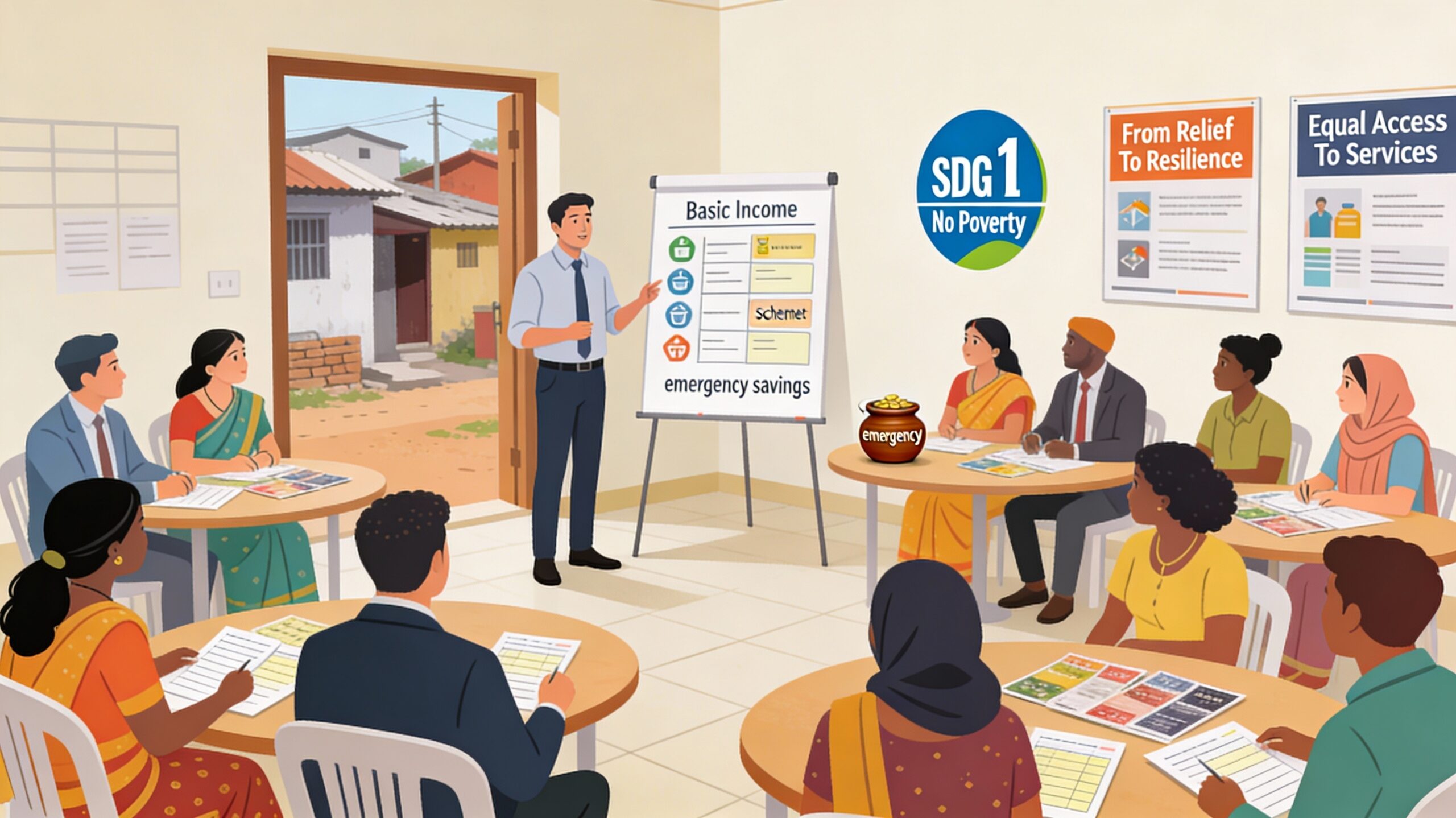
Why SDG 1 Needs Smarter Employee Engagement!
SDG 1, “No Poverty,” aims to end poverty in all its forms everywhere by tackling income poverty, deprivations in basic services, and vulnerability to shocks. It includes targets on eradicating extreme poverty (1.1), reducing poverty in all dimensions (1.2), expanding social protection (1.3), ensuring equal rights to resources and services (1.4), and building resilience to climate and economic shocks (1.5).
Most CSR-linked employee engagement on poverty still leans on drives: ration kits, clothes, or charity visits that may ease immediate distress but do little to shift livelihoods, resilience, or access to systems. NGOs can reframe SDG 1 engagement so employees contribute to financial inclusion, livelihoods, social protection access, and community resilience—supporting people’s own pathways out of poverty.
Shift The Lens: From Donation Drives To Income, Rights, And Resilience
Poverty is not only “lack of things”; it is lack of stable income, assets, social protection, voice, and buffers against shocks. SDG 1 explicitly calls for social protection floors, equal rights to economic resources, basic services, land and technology, and resilience to disasters and climate-related events.
An SDG 1–aligned approach asks:
- Do households have steady, dignified livelihoods and basic protections?
- Can they access schemes, services, financial tools, and markets without discrimination?
- Are they better able to absorb health, climate, or economic shocks?
Employee engagement can be designed to support these deeper shifts, with donations as one tactical piece, not the core.
Step 1: Anchor Engagement In SDG 1 Targets
Select SDG 1 targets where employees and CSR programs can add value:
- 1.1 – Eradicate extreme poverty (e.g., among specific groups or geographies in project areas).
- 1.2 – Reduce poverty in all its dimensions according to national definitions.
- 1.3 – Implement social protection systems and achieve substantial coverage of the poor and vulnerable.
- 1.4 – Ensure equal rights to economic resources, basic services, and financial services including microfinance.
- 1.5 – Build the resilience of the poor to climate, economic, and social shocks.
Position employee engagement primarily under 1.4 and 1.5 (financial inclusion, basic services, resilience) and link it to 1.1–1.2 through livelihoods and access work.
Step 2: Map Poverty Drivers, Systems, And Employee Levers
Work with CSR and field partners to map:
- Who is poor and why: local data on income, employment type, housing, debt, access to health and education, and exposure to climate/disaster risks.
- Existing safety nets: social protection schemes, pensions, PDS, health insurance, livelihood missions, self-help groups, and microfinance networks.
- Company footprint and leverage: hiring, supply chain, locations in high-poverty areas, financial services (if applicable), and employee skills in finance, tech, legal, HR, and operations.
This keeps engagement grounded in real SDG 1 gaps and opportunities, not abstract “rural upliftment.”
Step 3: Design A Poverty And Resilience Engagement Journey
Move from episodic philanthropy to a structured journey:
- Phase 1 – Poverty literacy: understanding multidimensional poverty, social protection, and dignity.
- Phase 2 – Financial literacy and inclusion: employees co-facilitate basic financial capability work with communities.
- Phase 3 – Livelihood and enterprise support: skills-based engagement with SHGs, youth, and small entrepreneurs.
- Phase 4 – Resilience and policy feedback: helping communities navigate schemes and feeding insights into CSR/HR/supply-chain strategies.
This approach reflects SDG 1’s mix of income, rights, and resilience.
High-Impact SDG 1 Employee Engagement Formats
- Poverty And Social-Protection Literacy Labs
Begin with sessions for employees that unpack SDG 1 and national poverty realities:
- Multidimensional poverty: income, housing, water, health, education, social exclusion.
- Key schemes: social protection floors, PDS, health insurance, pensions, livelihood missions.
- Why “helping the poor” must centre rights and systems, not only charity.
Similar, simplified versions can later be run with community groups, with local examples and safeguards.
- Financial Literacy And Inclusion Support
SDG 1.4 emphasises equal rights to economic resources and financial services. Employees with basic finance and digital skills can, under NGO and financial-inclusion partner guidance:
- Facilitate sessions on budgeting, debt management, savings, and safe use of digital payments.
- Help individuals or SHGs understand and use bank accounts, savings products, or insurance where appropriate.
- Support grievance-recording for fraud or exploitative lending cases, with clear referral to experts.
This strengthens people’s ability to manage money and shocks, a core resilience element.
- Livelihood, Skills, And Micro-Enterprise Clinics
NGOs running skilling or micro-enterprise programs can use employee capabilities to support SDG 1 and SDG 8:
- Business clinics for nano-entrepreneurs and SHGs: simple costing, pricing, record-keeping, and basic marketing.
- Exposure sessions for youth on realistic career paths, interview readiness, and workplace norms.
- Support to connect community enterprises into vendor ecosystems or local markets, where feasible and ethical.
These efforts contribute to 1.2 and 1.4 by improving incomes and market access.
- Social-Protection Navigation And Documentation Support
Access barriers to schemes often keep people in poverty. With strong safeguards and trained partners, employees can:
- Help community members understand eligibility and documentation requirements for key schemes.
- Support camps or help desks where people can check status, fill forms, or digitise documents (without making promises).
- Summarise common barriers for dialogue with local administrators and to inform CSR strategy.
This addresses SDG 1.3 by helping expand practical coverage of social protection.
- Resilience And Risk-Reduction Micro-Projects
Target 1.5 links poverty with vulnerability to climate and economic shocks. Employee engagement can include:
- Supporting community risk mapping (floods, heat, debt shocks, health costs) and simple preparedness measures.
- Co-creating micro-projects like raised platforms for assets, basic emergency communication trees, or savings groups aimed at shock buffers.
- Aligning with climate and disaster-mitigation work under SDG 13 and SDG 11.
This shifts engagement from “help after disaster” to building capacity beforehand.
Step 4: Safeguards, Power, And Respect
Poverty work is highly sensitive; ethical guardrails are essential:
- Avoid intrusive questioning about income, debt, or trauma in open groups; use trained facilitators and anonymous tools where needed.
- Do not frame people as helpless; foreground skills, networks, and existing strategies for coping.
- Ensure no one is pressured to take loans, insurance, or products through corporate/partner channels; separate education from sales.
A governance group (CSR, NGOs, possibly independent advisors) should regularly review practices and feedback.
Step 5: Metrics That Reflect Poverty Pathways
Move beyond “beneficiaries reached” and “kits distributed” by tracking:
- Households linked to and actually benefiting from social protection schemes, savings or insurance, and basic services.
- Livelihood outcomes where long-term work exists: stable earnings, diversified income sources, reduced distress migration or debt traps.
- Evidence of reduced vulnerability to shocks: emergency savings, use of formal safety nets, safer housing or assets.
- Policy and practice shifts: more inclusive hiring, vendor inclusion, or product design that supports low-income clients.
Where possible, align with national multidimensional-poverty indicators and SDG 1 targets (1.1–1.5).
Step 6: Storytelling That Centres Agency, Not Pity
Poverty stories easily fall into “rags to riches” or pity narratives. Better SDG 1 storytelling should:
- Show people as decision-makers and problem-solvers, not only as recipients.
- Highlight community organisations, women’s collectives, and youth groups as co-leaders.
- Connect individual stories to systemic changes (access to schemes, markets, protections), not just one intervention.
This reinforces poverty reduction as collective, structural work, not a series of heroic acts.
Written by Deb who is a social impact worker and part of letzrise team and stays in Bengaluru.