

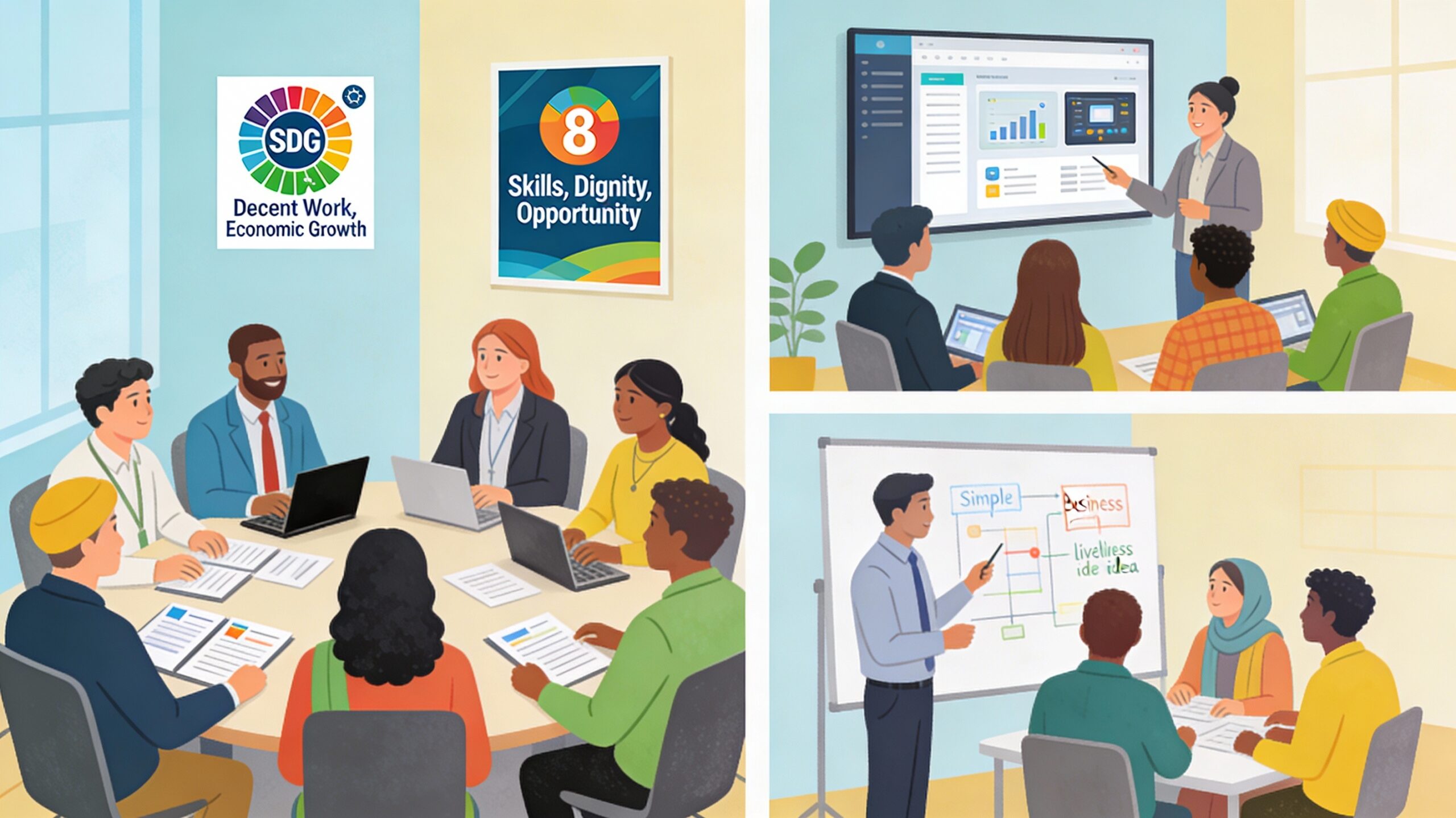
Why SDG 8 Is Bigger Than “More Jobs”
SDG 8, “Decent Work and Economic Growth,” calls for sustained, inclusive and sustainable economic growth, productive employment, and decent work for all. It emphasises not just more jobs, but safe working conditions, fair income, social protection, and opportunities for young people, women, and vulnerable groups.
Most CSR programs already touch SDG 8 through skilling, entrepreneurship, and livelihood projects, but employee engagement often stays at the periphery as mock interview days or guest lectures. NGOs can turn employees into partners in building decent work pathways, not just visitors to training centres.
Shift The Lens: From “Training Hours” To Decent Work Pathways
Traditional CSR metrics around SDG 8 focus on number of people trained, centres opened, or sessions conducted. These are necessary but not sufficient; many trainees still struggle to find stable, safe, fairly paid work or to grow micro-enterprises beyond survival level.
An SDG 8–aligned employee engagement strategy asks sharper questions:
- Are learners transitioning into decent work, not just any work?
- Are women, youth, and marginalised groups getting fair opportunities?
- Are enterprises and jobs climate- and rights-aligned, not exploitative?
Employees can help answer these questions by offering skills, networks, and practical insights into what hiring managers and markets actually expect.
Step 1: Anchor The Program In SDG 8 Targets
Frame your engagement design around a few SDG 8 targets that employees can realistically influence:
- 8.5 – Achieve full and productive employment and decent work for all women and men, including youth and persons with disabilities, with equal pay for work of equal value.
- 8.6 – Substantially reduce the proportion of youth not in employment, education, or training (NEET).
- 8.3 – Promote development-oriented policies that support productive activities, decent job creation, entrepreneurship, and growth of micro-, small- and medium-sized enterprises.
Position employee engagement as contributing directly to 8.6 (youth employability) and 8.5 (pathways to decent work), with support for 8.3 when staff mentor entrepreneurs and producer groups.
Step 2: Map Labour-Market Realities And Employee Levers
Before creating formats, NGOs should work with CSR and HR to map:
- Local labour-market trends: high-demand roles, sectors in decline, typical wages, working conditions, and gender or caste barriers.
- Existing CSR skilling/livelihood programs: target groups, course content, placement partners, and gaps between training and job/enterprise outcomes.
- Employee levers: hiring decisions, vendor choices, on-the-job mentoring capacity, professional networks, and lived experience of different career paths.
This ensures engagement is grounded in real SDG 8 challenges, not generic “skills for youth” narratives.
Step 3: Design A Decent-Work Journey For Employees
Instead of sporadic volunteering, design a structured journey for employees:
- Phase 1 – Understand: sessions on SDG 8, local labour markets, and “decent work” principles.
- Phase 2 – Engage: regular mentoring, mock interviews, exposure visits, and skills-based inputs to training centres.
- Phase 3 – Co-create: employees and NGOs refine curricula, bridge modules, and placement/enterprise support based on actual hiring expectations.
- Phase 4 – Advocate and integrate: insights feed into company hiring, vendor practices, and CSR–HR alignment.
This mirrors SDG 8’s focus on systems—education → training → decent work—rather than isolated activities.
High-Impact SDG 8 Employee Engagement Formats
- SDG 8 Literacy And “Decent Work” Clinics
Begin with interactive sessions for employees explaining SDG 8: what “decent work” means (fair income, safety, social protection, voice, equal opportunity) and how informal, precarious work affects millions. Bring in youth or workers from partner communities (or anonymised stories) to illustrate real barriers to entry and advancement.
These clinics can also unpack company policies on safe workplaces, non-discrimination, and living wage discussions, connecting internal HR agendas with external CSR commitments.
- Mentoring, Mock Interviews, And Career Navigation
Employees can provide high-value support by mentoring young people from underserved communities and conducting structured mock interviews. NGOs can design:
- Short mentoring cycles (e.g., 4–6 sessions) focused on career clarity, CV building, professional communication, and navigating the first 90 days of a job.
- Mock interviews aligned with real job roles, with clear feedback on strengths and gaps.
This directly supports SDG 8.6 by helping youth move from training into employment with more confidence and realistic expectations.
- Skills-Based Inputs To Training And Curriculum
Too often, training curricula lag behind market needs. Employees can help bridge this gap by:
- Reviewing course content for relevance and suggesting updates (e.g., digital tools, workplace etiquette, basic compliance).
- Co-facilitating short modules on industry trends, workplace culture, customer orientation, and rights at work.
- Designing micro-projects or assignments that mimic real-world work scenarios.
This ensures SDG 8 skilling programs better equip learners for actual workplaces, not just exams.
- Support For Micro-Entrepreneurs And Producer Groups
SDG 8.3 stresses entrepreneurship and MSMEs as engines of decent work. NGOs working with self-help groups, artisans, farmers, or nano-entrepreneurs can structure employee engagement as:
- Business clinics on costing, pricing, record-keeping, and cash-flow management.
- Branding and digital-marketing support for local products and services.
- Market-linkage conversations where procurement teams explore responsible sourcing from local producers.
This links SDG 8 to SDG 9 and SDG 1, turning employee skills into leverage for more resilient local economies.
- Internal “Decent Work” Champions And Policy Feedback
Employees can also be champions for improving work conditions within their own organisation and among key vendors. NGOs can help:
- Facilitate feedback loops where employees and contract staff surface concerns about workload, safety, or discrimination.
- Co-design small pilots—e.g., better onboarding for first-generation corporate workers, mental-health support, or safer workplace protocols.
This signals that SDG 8 is not only about “others out there,” but about the company’s own practices too.
Step 4: Governance, Safeguards, And Ethics
Work on jobs and livelihoods involves real economic stakes and power imbalances. NGOs should:
- Ensure mentoring and interview sessions are trauma-informed and do not shame participants for their current situation.
- Be clear about what employees and companies can and cannot promise—no guaranteed jobs unless formal pathways exist.
- Protect learners from exploitative offers or inappropriate data requests during engagement.
A joint governance group (CSR, HR, NGO, and, where appropriate, training partners) should oversee design, feedback, and resolution of grievances.
Step 5: Metrics That Reflect Decent Work, Not Just Training
Effective SDG 8 metrics go beyond “number trained.” NGOs and corporates can track:
- Placement rates into jobs meeting minimum “decent work” criteria (wage thresholds, formal contracts where possible, basic safety).
- Retention beyond 6–12 months, not just first placement.
- Growth in income or business stability for entrepreneurs and producer groups.
- Number of mentoring cycles, mock interviews, and curriculum improvements co-created with employees, and learner feedback on their value.
Where feasible, tie these to SDG 8 indicators and national skilling benchmarks so impact is visible in CSR and ESG reports.
Step 6: Storytelling That Centres Dignity, Not Charity
Stories about skilling and jobs can slip into “from poor to successful” tropes that flatten people’s lives. Instead, NGOs can help shape narratives that:
- Highlight learners’ hard work, resilience, and aspirations, with employees as supporters, not saviours.
- Show realistic journeys: setbacks, lateral moves, and gradual improvement rather than overnight success.
- Explicitly link each story back to SDG 8—decent work, fair conditions, and long-term economic security.
This builds a healthier culture around SDG 8: dignified work as a right, not a favour.
Written by Deb who is a social impact worker and part of letzrise team and stays in Bengaluru.