

Why LTV Matters for Indian NGOs- For Indian NGOs, monthly donors are not just a steady revenue stream; they are long‑term partners who decide how far programmes can grow. Donor lifetime value (LTV) helps organisations shift from chasing “new donors this month” to designing relationships that maximise the long‑term value and impact of every supporter.
What LTV Means in Monthly Giving (Using ₹750 as an Example)
LTV for a monthly donor is the total of all gifts they make over the time they stay with you, plus any upgrades or extra contributions along the way. For a face‑to‑face donor giving ₹750 a month, if the average relationship lasts 30 months, that single decision on a street or at a mall is suddenly worth ₹22,500 in lifetime value, compared to a one‑time gift of perhaps ₹1,500–₹2,000 from the same person.
A simple way to explain it in your NGO is: LTV = ₹750 (average monthly gift) × 12 (months) × 2.5 (average years a donor stays) ≈ ₹22,500. When teams see this, every extra month of retention for a ₹750 donor stops feeling like a small win and starts looking like several thousand rupees of added impact.
Meet the Indian Everyday Monthly Donor- Studies on “everyday giving” in India show that ordinary citizens are willing to give small but meaningful amounts regularly when giving is convenient and impact is visible. These everyday donors include salaried youth, middle‑class families, homemakers and retirees who might comfortably commit around ₹500–₹1000 a month, making ₹750 a very realistic entry point for urban face‑to‑face fundraising.
Four triggers repeatedly show up in Indian research: convenience, urgency, community and impact, which is why monthly giving programmes that are easy to set up, emotionally compelling and socially visible tend to do better. This aligns strongly with the way donors respond to street and venue fundraisers—there is a human connection, a sense of being part of something bigger, and a clear ask they can act on immediately.
Cause‑Specific Storytelling that Deepens LTV- Different causes need different narratives to build loyalty over time: for children, continuity in schooling and nutrition; for women, livelihood and safety; for climate and animals, protection and restoration; for disability and health, dignity and long‑term care. A ₹750/month donor is more likely to stay if they repeatedly see how that amount translates into specific outcomes such as school days funded, therapy sessions supported, meals provided or animals treated.
Indian donors also respond well to stories rooted in local realities and regional languages, especially when they connect individual impact to broader systemic change. Over time, this style of storytelling turns a ₹750 “good deed” into a relationship where donors feel emotionally invested in the children, women, communities or animals they support.
Make Monthly Giving Frictionless and India‑Ready- No matter how inspiring your cause is, people will not sign up or stay if monthly giving feels complicated. In India, this means having simple, mobile‑friendly forms, making “monthly” the default option, and offering frictionless methods such as UPI Autopay, cards, net banking and wallets through a reliable payment gateway.
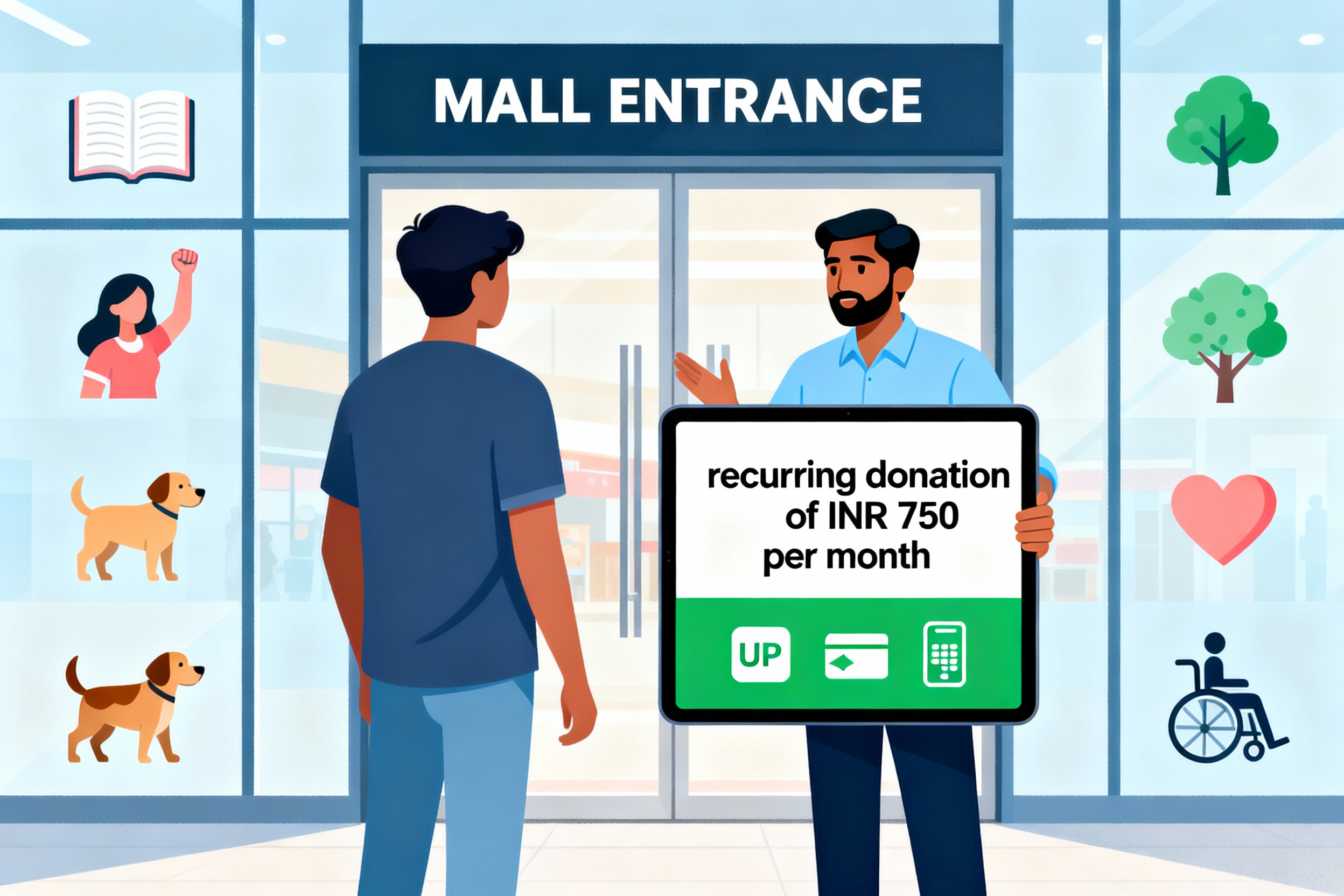
For a ₹750/month street donor, the ideal experience is: meet fundraiser → understand impact → scan a QR code or sign a recurring mandate → receive an instant confirmation on SMS or WhatsApp. When donors can set up a recurring ₹750 contribution in a few taps, they are far more likely to join and far less likely to cancel due to process fatigue.
Offline vs Digital Acquisition: Different Roads, Same Destination- Indian NGOs today typically acquire monthly donors in two ways: offline (streets, venues, door‑to‑door, events) and online (website, social media, crowdfunding, digital ads). Face‑to‑face donors often start higher—₹750/month is a common and comfortable ask in urban venues—while digital donors may enter at ₹300–₹500, yet both groups can reach strong LTV if their journeys are designed well.
Offline channels have front‑loaded costs: training, salaries, permissions and travel mean the programme only becomes profitable when a ₹750 donor stays long enough and possibly upgrades later. By layering digital tools—WhatsApp updates, email journeys and UPI Autopay links—on top of these street‑acquired relationships, NGOs can extend tenure and ensure that the true LTV of each ₹750 donor is realised.
Onboarding: The First 90 Days Decide Your LTV- The first three months are when many donors decide whether to stay or quietly cancel, which is why onboarding is mission‑critical. If a ₹750/month donor stops in month four, their LTV is just ₹3,000, but if they stay 30 months, the same donor is worth ₹22,500—so what you do in those early days can be worth nearly ₹20,000 per donor.
An effective onboarding journey for a face‑to‑face ₹750 donor can include an immediate thank‑you SMS and WhatsApp, a welcome email with a photo of the team they met, and a short impact story within the first month showing exactly what one month of ₹750 achieved. A quick welcome call for higher‑value donors (for example, anyone at ₹750 and above) often reduces early attrition because it reinforces their decision and gives them a real person and number to trust.
Retention: Build Trust, Belonging and Reliability- High LTV is impossible without strong retention, and retention is built on trust, timely communication and a feeling of belonging. For Indian NGOs, this translates into sending 80G receipts on time, sharing regular impact updates, using WhatsApp/SMS and email effectively, and positioning monthly donors as part of a named “circle” or “community” rather than just a database segment.
Over time, inviting ₹750 donors to online town halls, field visit videos or festival‑time gratitude messages can deepen their sense of connection and reduce cancellations. When donors feel seen and valued as partners, they are more willing to keep that ₹750 commitment going even through personal ups and downs.
Smart Upgrades: Growing Value Without Losing Heart- Once donors have been with you for 9–12 months and have consistently seen impact, many are ready to do a little more. A respectful upgrade ask might invite a ₹750 donor to move to ₹900 or ₹1,000, framed not as “pay more” but as “support one more child’s classes, a few more medical visits, or care for one more animal each month”.
From an LTV perspective, this is powerful: moving a loyal donor from ₹750 to ₹1,000 part‑way through their journey can add thousands of rupees in value with almost no new acquisition cost. The most effective upgrade appeals reference the original face‑to‑face moment—“You met our team outside the mall last year and started a ₹750/month pledge”—and are used sparingly so that donors never feel pressured or taken for granted.
Reduce Churn: Fix Payment and Engagement Leaks- LTV drops fastest when donors churn, whether because of payment failures (involuntary churn) or a conscious decision to stop (voluntary churn). For a cohort of 100 face‑to‑face donors at ₹750/month, early churn can mean losing several lakhs of potential lifetime value if many never make it past the first year.
NGOs can prevent a lot of this leakage through better systems: auto‑retries on failed payments, reminders before card expiry or UPI mandate lapses, easy ways to update details, and options to pause or downgrade instead of cancelling. When a ₹750 donor says they are struggling, offering a temporary drop to ₹500 or a three‑month pause often saves the relationship and preserves a large portion of their future LTV.
Use Data and Segmentation Like a Fundraising Lab- Even simple tracking—such as average tenure, average monthly gift, and LTV by channel—can dramatically improve decisions. For example, you may find that face‑to‑face ₹750 donors stay longer than lower‑value digital donors, which justifies investing more in their onboarding and retention journeys.
Segmenting donors by tenure (new vs loyal), value (₹750 and above vs below), and channel (street vs digital) allows you to tailor communication and stewardship intensity. High‑LTV segments can receive more personalised calls and stories, while lower‑value segments can be nurtured with automated but thoughtful WhatsApp and email flows.
Build Internal Systems and Culture Around Monthly Giving- Monthly donors deliver high LTV only when the whole organisation treats them as strategic assets. This means leadership, programme teams, communications and finance all owning the donor experience, not just the fundraising department.
Practical steps include monthly dashboards that show key LTV indicators, internal sharing of donor stories, and performance metrics that reward retention and upgrades instead of acquisition alone. When teams understand that keeping a ₹750 donor for one extra year may be more valuable than signing up three new short‑term donors, behaviour begins to shift.
Quick Wins and Long‑Term Plays for Indian NGOs
In the next 30–60 days, Indian NGOs can boost LTV by making monthly the default ask, tightening payment flows, launching a simple WhatsApp‑based welcome and impact series, and running one carefully framed upgrade campaign for long‑standing ₹750 donors. Over the longer term, the organisations that win will be those that combine India‑friendly technology such as UPI Autopay, authentic storytelling, and deep respect for the everyday giver, treating every ₹750 monthly donor as a long‑term partner in change rather than a line item in a spreadsheet
Written by Deb who is a social impact worker and part of letzrise team and stays in Bengaluru.