

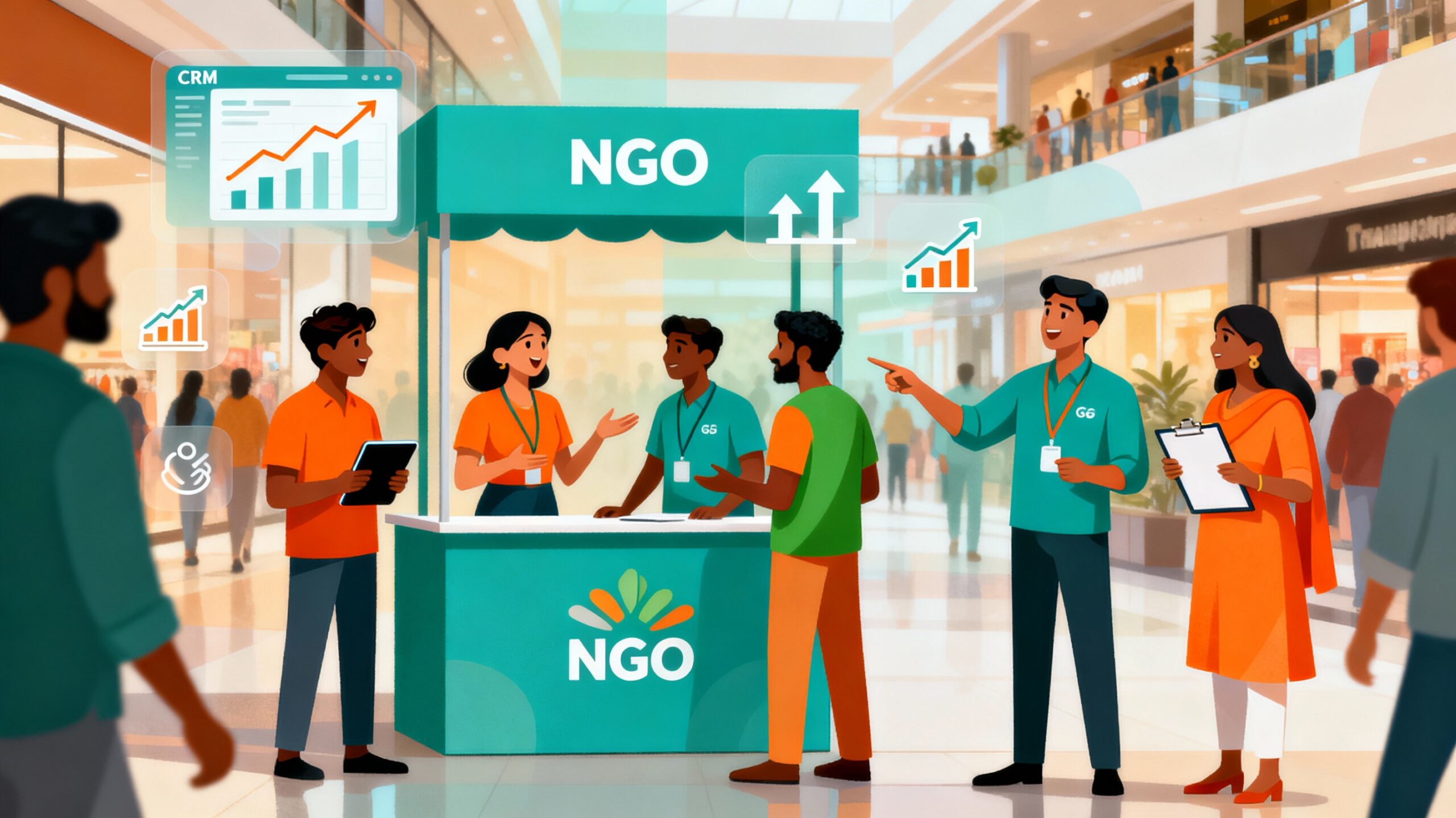
India’s NGOs are putting more energy than ever into retail fundraising—monthly giving, face‑to‑face, events, and small online donations. Yet the one thing that can truly unlock these channels—a stable, skilled fundraising team—is exactly where most organisations are struggling.
The paradox of retail fundraising in India- Across India, reports show individual and small donations growing steadily, even as CSR and institutional funding become more volatile. Everyday givers are willing to support causes year after year, but NGOs that try to build their own in‑house retail programmes quickly run into a wall: they cannot find, train, and retain the people needed to drive acquisition and build long‑term relationships.
Mid‑sized NGOs feel this most acutely. They are large enough to know that retail fundraising matters, but not yet resourced like big national brands that can afford agencies, city offices, or large teams. So, leaders end up doing “a bit of everything”—a crowdfunding campaign here, a mall activity there—without ever building a serious retail engine.
Why Indian NGOs are starved of fundraising talent- Multiple studies point to the same pattern: Indian nonprofits struggle to recruit and retain competent fundraising staff at all levels. Organisations report that they often compromise on qualifications and experience, delay hiring for critical roles, and lose people just when they start to become effective.
The reasons are familiar but important to name clearly: salaries that lag behind the private sector, limited benefits, few structured growth paths, and a perception that fundraising is a “necessary evil” rather than a respected profession. For frontline roles in particular—face‑to‑face fundraisers, tele‑callers, event staff—the work is demanding, target‑driven, and often under‑supported, so people burn out fast.
At the same time, sector research shows that Indian NGOs underinvest in core capabilities like fundraising and HR because they fear donors will not fund “overheads”. This scarcity mindset keeps teams thin and fragile, which in turn keeps results modest—reinforcing the belief that retail fundraising “doesn’t work” or is “too expensive”.
How talent gaps weaken retail fundraising- When there is no stable, experienced team behind your campaigns, the impact shows up everywhere—from the street to the CRM.
How talent gaps hit Indian retail fundraising
| Problem in teams | Visible fundraising impact |
| High churn in field fundraisers | Constantly restarting acquisition, weaker donor conversations, and poor conversion in malls, events, and public spaces. |
| Few experienced managers | Weak training, poor site or channel selection, unrealistic targets, and no time for coaching. |
| Thin donor care / back‑office | Delayed receipts, poor follow‑up, low retention and upgrade rates from individual givers. |
For mid‑sized NGOs, this often looks like a permanent “pilot mode”: every year there is a new agency, a new tele‑calling vendor, a new campaign, but no institutional memory or in‑house capability is built. Teams chase short‑term numbers—how many sign‑ups this month—without the people, systems, or patience to track long‑term value from those donors.
Root causes in the Indian context- Behind the talent crisis in retail fundraising are a few structural issues that Indian NGO leaders must confront head‑on.
First, funding models and mindsets still tilt heavily towards projects. Many funders restrict how much can be spent on staff, fundraising, or technology, and NGOs internalise this by cutting core investments to “look lean”. Capacity‑building case studies in India show that where organisations received flexible, multi‑year support to strengthen fundraising and operations, their ability to raise money from individuals increased significantly—but such grants are still rare.
Second, pay and progression in fundraising are poorly structured. HR research on Indian NPOs highlights low salaries, limited non‑salary benefits, and unclear growth paths as major reasons people exit the sector or do not join at all. For someone with strong communication or sales skills, a corporate BD or sales role looks far more attractive than standing at a stall in a mall or calling donors from a basic call centre.
Third, fundraising is often fragmented across the organisation. One person looks after CSR, another “helps with campaigns”, the CEO signs off on everything, and nobody owns building a pipeline of small, committed donors year after year. Retail initiatives become one‑off experiments rather than a sustained strategy—so even when a campaign does well, the team disbands and the learning vanishes.
What mid‑sized NGOs can fix internally- The good news is that many of the levers sit within the control of NGO leadership and boards. It is possible to build a serious retail engine, even with modest budgets, if fundraising capacity is treated as core infrastructure rather than an afterthought.
Treat fundraising capacity as a core investment- Indian philanthropy reports and capacity‑building initiatives repeatedly stress that funding core capabilities like fundraising, HR, and finance delivers outsized long‑term returns compared to project‑only grants. As a leader, that starts with an explicit decision: a fixed percentage of the organisation’s budget—however small today—will be invested every year in building fundraising people and systems.
This can look like budgeting for two full‑time fundraising roles instead of one, allocating modest funds for training and coaching, and setting aside resources for simple but reliable tech tools (from CRMs to payment gateways) that make your team’s life easier. Over time, as individual giving grows, part of that incremental income feeds back into strengthening the same engine.
Build real roles and career paths in retail fundraising- Instead of hiring “one fundraiser who does everything”, define a clear path: Fundraiser → Senior Fundraiser → City / Channel Lead → Individual Giving Manager → Head – Fundraising, with written responsibilities and competencies at each level. Sector evidence shows that organisations with defined growth paths and transparent performance expectations are better at retaining talent over time.
For frontline and mid‑level roles, redesign performance metrics so they are not only about monthly sign‑ups. Link a portion of incentives and appraisals to donor retention at 6–12 months, upgrade rates, and quality indicators like accurate data collection and complaint rates. This encourages fundraisers and managers to prioritise meaningful conversations and ethical practices, not just “closing” donors at any cost.
Set up a simple “fundraising academy”- Many Indian NGOs say they are eager to do more fundraising but lack knowledge of how to run campaigns, use digital channels, or make strong asks. Instead of waiting for external workshops, mid‑sized organisations can create a light but consistent internal academy.
This could include structured onboarding for every new fundraiser, regular role‑plays and pitch practice, monthly skills clinics on topics like “handling objections” or “using stories ethically”, and at least one immersion visit where fundraisers see programmes first‑hand. Over time, your senior fundraisers and managers become trainers themselves, reducing dependence on external consultants while raising the baseline quality of your whole team.
Make frontline roles humane and aspirational- Research on HR in Indian nonprofits is clear: people stay when they feel safe, valued, connected to the mission, and able to grow—not only when they earn a bit more money. For retail fundraising teams, this can be translated into a few concrete practices.
Design predictable schedules and rest days so fundraisers are not constantly exhausted. Put in place clear safety protocols and grievance mechanisms, especially for women working in public spaces or late evenings. Provide basic benefits such as health insurance, reimbursements, and learning allowances where possible, and be generous with recognition—monthly shout‑outs, certificates, internal newsletters featuring fundraisers and their stories. These are simple, affordable ways to signal that fundraising is valued work, not just a numbers game.
Use technology and data to support small teams- Indian examples show how even modest investments in donor CRMs, automation, and digital journeys can transform follow‑up and retention. For NGOs that cannot yet afford sophisticated systems, disciplined use of simple tools—structured Google Sheets, templated WhatsApp journeys, basic email and SMS tools—can still make a big difference. The aim is to free your fundraisers from manual drudgery so they can spend more time talking to donors and less time chasing data and receipts. When you start tracking basic indicators—where donors came from, which conversations convert best, what retention looks like by channel—your managers can make smarter decisions about where to send teams and how to refine pitches.
What the ecosystem can do to help- Of course, NGOs cannot solve this alone. Funders, platforms, and larger organisations have a crucial role in turning fundraising into a respected, sustainable career path in India.
First, more funders need to explicitly support capacity‑building. Case studies from India show that when philanthropies back HR, fundraising, and systems over multiple years, partner NGOs are able to stabilise teams and significantly grow their own revenue, including from individuals. Everyday‑giving research is already nudging donors to see acquisition and retention costs as investments rather than leakage.
Second, sector platforms and intermediaries can expand shared training and talent pipelines. Programmes run by leadership and capacity‑building organisations already offer workshops on fundraising and leadership, but these could evolve into joint “fundraising academies” for frontline staff, managers, and emerging leaders from multiple NGOs. Pooled recruitment, fellowships, or rotational placements can spread costs while building a community of practice around ethical, data‑driven retail fundraising.
Finally, the narrative around fundraising careers must change. Commentators in India argue that fundraising should be treated as a strategic leadership function, not simply a sales task delegated to the youngest staff. Larger NGOs and networks can help by showcasing fundraiser success stories, engaging with universities and management institutes, and creating visible role models who demonstrate that one can build a serious, impactful career in fundraising.
A call to action for NGO leaders- For mid‑sized Indian NGOs, the choice is stark and simple. Everyday giving and small donors are becoming one of the most resilient income streams in a funding landscape where CSR rules, government priorities, and institutional agendas can change quickly. But retail fundraising will not scale on campaigns alone; it will only scale on the back of strong, supported, and respected people.
The real bottleneck is not donor generosity—it is the sector’s willingness to invest in fundraising talent, systems, and culture with the same seriousness given to programmes. For leaders who decide to make that shift, retail fundraising can move from being an annual experiment to becoming a reliable, mission‑critical engine that sustains their work for decades to come.
Written by Deb who is a social impact worker and part of letzrise team and stays in Bengaluru.