

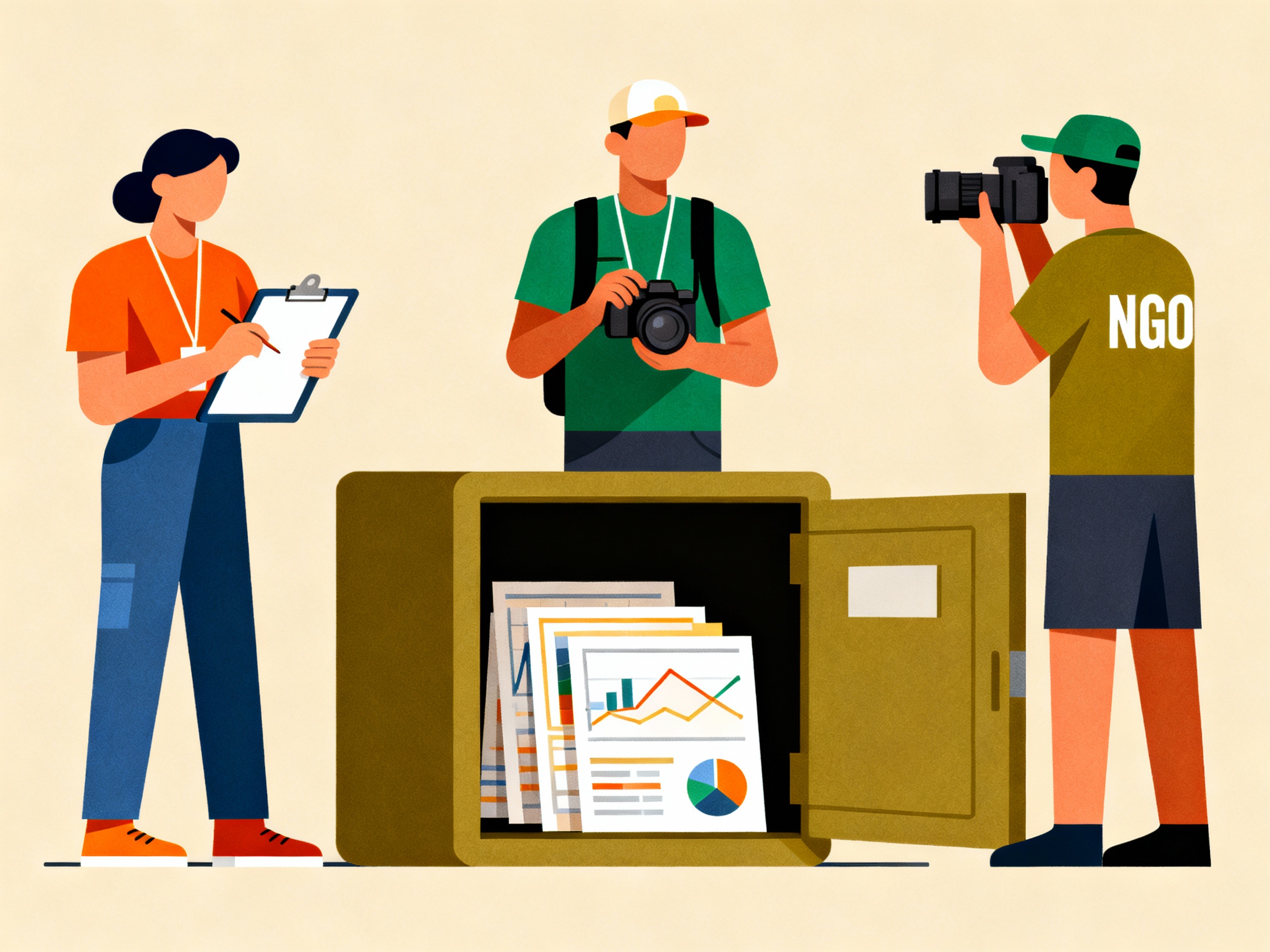
Limited documentation of evidence quietly weakens even the best NGO work, because funders cannot “see” the change beyond stories and activity reports. This blog looks at how simple monitoring, evaluation, and documentation habits can transform credibility with CSR and institutional donors.
Why Evidence Matters
For NGOs and CSR projects, data and documentation are no longer “nice to have” but central to proving effectiveness and securing long-term funding. Donors increasingly expect clear baselines, measurable progress, and credible stories backed by numbers and external validation.
Step 1: Set Up a Simple M&E System
Monitoring and Evaluation (M&E) does not have to be complex or expensive to be useful. What matters is a basic structure that helps you track where you started, what changed, and what that means for people’s lives.
For each project, define three measurement points:
- Baseline: Situation before the project starts.
- Midline: Progress check during implementation.
- Endline: Situation at (or after) project completion.
Use standard tools as far as possible so your data is comparable and credible:
- Learning assessments for education projects.
- Knowledge, Attitude, Practice (KAP) surveys for health and behaviour change.
- Income and asset tracking tools for livelihoods.
Keep the indicator list small and realistic, but make sure it covers reach (who), depth (how much change), and quality (how good that change is).
Step 2: Build an Evidence Repository
Many NGOs have great stories and photos scattered across phones, WhatsApp, and personal laptops. An evidence repository consolidates everything in one organised space so that proposal writers, leadership, and fundraisers can access it instantly.
Create a central drive or folder structure (e.g., by project and year) that includes:
- Photos with captions, dates, locations, and consent documentation.
- Short raw videos or edited clips from the field.
- Beneficiary quotes and testimonials with basic context.
- Case studies of individuals, groups, or communities.
- Survey reports, dashboards, and internal M&E summaries.
- Third-party evaluations, audit reports, and relevant media coverage.
This becomes your “evidence bank” that feeds into proposals, reports, social media, and donor meetings.
Step 3: Standard Field Documentation Protocol
Good evidence starts in the field, not in the proposal office. Field teams need clear, simple guidelines so documentation is consistent across locations and staff.
Train field teams on:
- How many photos to capture per event or visit (for example: opening, activity in progress, close-up of interaction, group shot, and context shot).
- Basic framing: faces visible, activities clear, no sensitive details exposed, safe and dignified portrayal of participants.
- How to collect and record consent (written, audio, or video), including how photos and quotes may be used.
- Capturing before–after data and visuals wherever possible (e.g., pre- and post-test sheets, house or school conditions, income records).
Turn this into a one-page checklist or SOP and include it in induction for all new program staff.
Step 4: Commission or Partner for Independent Evaluation
An external evaluation, even if limited in scope, can create a step change in how serious funders perceive your organisation. Independent studies signal that you are open to scrutiny, learning, and improvement—not just self-promotion.
Options include:
- Commissioning a small endline or thematic study with an evaluation or CSR research firm.
- Partnering with an academic institution or research centre for a student-led or faculty-supervised evaluation.
- Joining multi-partner evaluations where several NGOs in a geography or theme are studied together.
Highlight key findings—both successes and lessons learned—in proposals and presentations to show maturity and transparency.
Step 5: Track KPIs for Evidence and Learning
To move from ad-hoc documentation to a culture of evidence, organisations need to track a few simple internal KPIs. These metrics help leadership understand whether data and documentation systems are actually working.
Examples of evidence-related KPIs:
- Percentage of projects with baseline, midline, and endline data available.
- Number of high-quality case studies produced per quarter (with data, quotes, and visuals).
- Number or percentage of projects with external evaluations completed or underway.
- Percentage of proposals that include robust evidence (data tables, graphs, case studies, evaluation findings).
Sample Evidence and M&E KPI Framework
| Area | Example KPI |
| Data completeness | 80% of active projects have baseline, midline, and endline data documented. |
| Story quality | 10+ evidence-based case studies produced and approved per quarter. |
| External credibility | At least 2 independent evaluations completed each year. |
| Proposal strength | 90% of proposals include quantitative data and at least one case study. |
From “We Think It Works” to “Here’s the Evidence”
When NGOs invest in simple M&E systems, organised repositories, disciplined field documentation, and at least one external evaluation, the conversation with donors shifts. You move from saying “We believe our model works” to confidently stating “Here is the data and human stories that show our impact—and what we are improving next.”
Written by Deb who is a social impact worker and part of Letzrise team and stays in Bengaluru.