

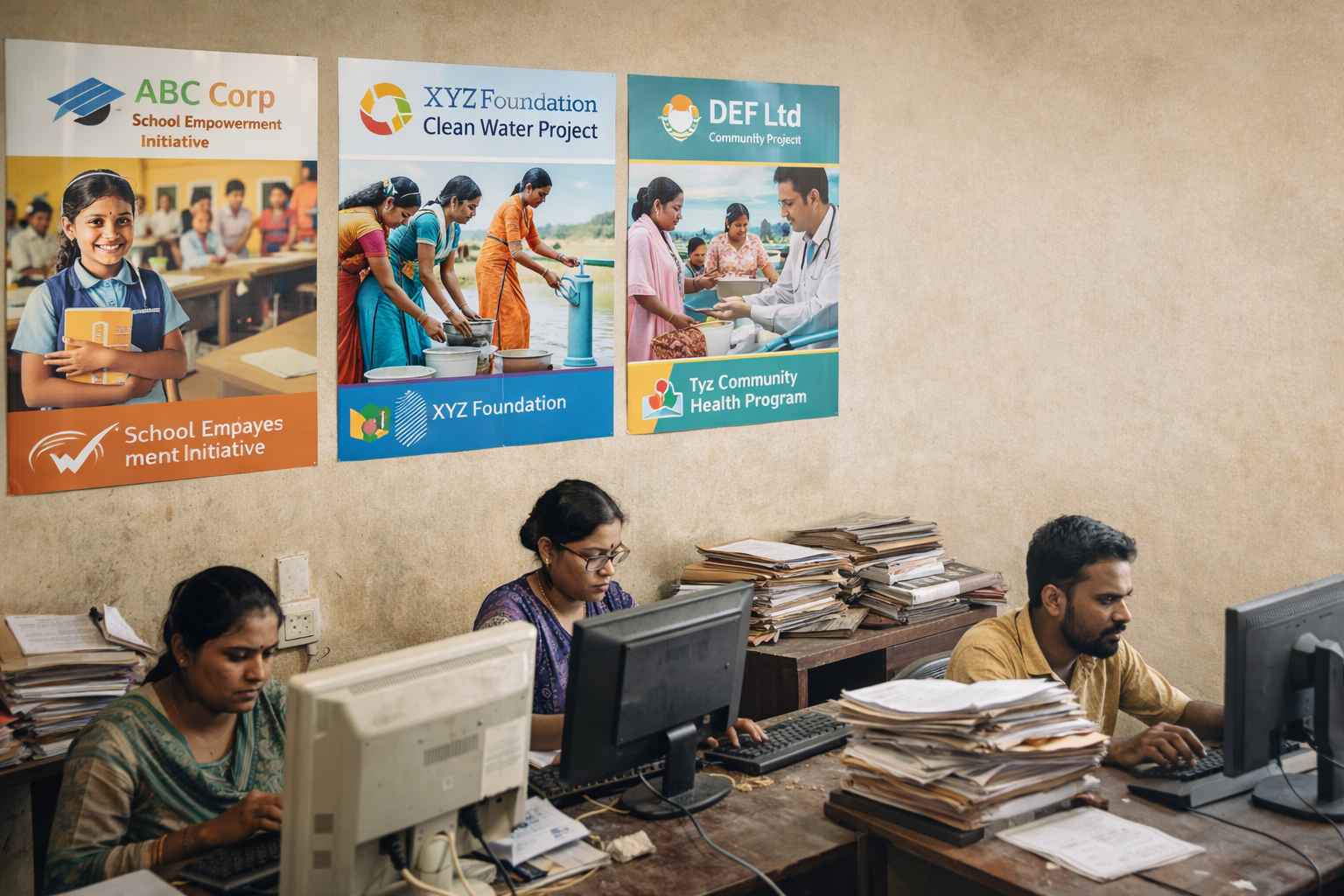
In the last few years, I’ve heard a similar line from many NGO leaders across India: “Maximum donor agencies have drastically cut down the admin cost and there is literally no OD budget left. Life has become so challenging for communitarian NGOs like us.”
This is not just a funding complaint. It is a structural crisis. NGOs are being asked to deliver deeper impact, tighter compliance, and more “innovation” – but with shrinking support for the very people, systems, and capacities that make any of this possible. When we celebrate projects and starve organisations, we set up communities – and changemakers – to fail.
Projects funded, organisations starved- Across the sector, we hear the same success mantra: “95% to programmes, only 5% to admin.” It sounds efficient and donor-friendly, but on the ground, it often means underpaid staff, no HR support, weak finance systems, little or no M&E, and almost zero investment in leadership development.
For communitarian NGOs rooted in villages, small towns, and urban settlements, this hits hardest. These organisations depend on local leaders who know the community deeply, but they struggle to retain them because grants won’t pay adequately for salaries, mentoring, or basic organisational systems. Over time, good people burn out or leave, not because they lack passion, but because the system around them is too fragile to sustain their work.
How current CSR and donor norms fuel the problem- Many CSR policies cap administrative overheads and treat OD (organisation development) as a “nice to have” rather than a core need. Short-term, projectised funding further tightens the space: donors commit for one or two years, expect visible outcomes, but are reluctant to invest in the less glamorous backbone of impact – systems, people, and learning.
For communitarian NGOs, which rarely have large reserves or multiple income streams, this becomes a trap. They cannot cross-subsidise OD from other sources, yet they are expected to meet increasing demands on reporting, compliance, technology, and scale. In practice, when funders proudly say “we do not fund admin, only direct project costs”, what they often mean is: “we do not fund people, systems, or long-term resilience.”
What this looks like on the ground-On the ground, the consequences are painfully visible. Teams operate with skeletal staff; one person may juggle programme implementation, reporting, finance documentation, and community mobilisation. Burnout becomes normalised. Young leaders, who enter the sector with energy and idealism, often exit within a few years because they see no pathway for growth, stability, or learning.
At the same time, expectations keep rising. Donors want real-time data, robust MIS, impact dashboards, and social media storytelling, often without funding the positions or tools needed to do any of this well. The result is a quiet erosion of quality: errors in data, weak follow-up with communities, poor documentation, and, at times, damaged trust when programmes have to shut down abruptly due to funding gaps.
OD and “admin” are actually programme costs- The core misunderstanding is this: OD and “admin” are seen as overheads separate from impact, rather than as integral parts of it. In reality, supervision, field coordination, MIS, M&E, training, community mobilisation, financial management, and leadership development are all essential to programme quality and risk management.
Funding OD is not charity for NGOs; it is risk mitigation and impact insurance for donors. Strong systems protect against fraud, ensure compliance, improve data quality, and create continuity even when individuals change. Every strong programme stands on an “invisible backbone” of administration and OD. When we cut that backbone, the body may still move for a while – but it is already fragile.
What communitarian NGOs can do- While the structural problem is real, communitarian NGOs are not powerless. There are at least four practical ways to respond.
- Reframe OD within project design:
Instead of showing OD as a separate cost head, integrate key capacity elements into the programme itself – field coordination, community facilitators, supervision, MIS, M&E, and leadership development as clear deliverables linked to outcomes. - Build small flexible income streams:
Explore local philanthropy, individual donors, HNIs, and small community contributions that can be earmarked for staff welfare, systems, and buffers. Even modest cores – like a consistent local giving base – can provide breathing space for salaries and basic OD. - Use low-cost capacity-building:
Tap skills-based volunteers, CSR employee engagement, and pro‑bono experts in areas like finance, HR, fundraising, digital, and M&E. Design time‑bound OD sprints, for example, “90 days to set up a basic MIS and reporting framework” or “six months of fundraiser coaching for the team”, with clear outputs. - Prioritise a few core systems:
Instead of trying to fix everything, focus on two or three backbone areas – for instance, finance systems, HR policies, and a simple but reliable M&E framework. Strengthening a few critical systems deeply can be more transformative than spreading resources thin across many fronts.
What donors and CSR teams can do differently- On the donor side, relatively small shifts in mindset and policy can unlock significant value.
- Allow realistic indirect cost percentages:
Move away from arbitrary low caps and acknowledge the “true cost” of impact. Even incremental increases in allowable overheads, backed by transparent cost discussions, can make a huge difference. - Create OD windows within programme grants:
Earmark part of the budget for organisation strengthening – leadership coaching, HR capacity, financial systems, tech tools, and documentation. Treat these as core risk management components, not extras. - Commit to 2–3 year organisation-building roadmaps:
Beyond annual projects, co-create a medium-term plan with partner NGOs that covers programme growth and institutional health side by side. This includes investing in people, succession planning, and systems that will outlast any single project. - Measure and celebrate OD outcomes:
Look beyond only “number of beneficiaries reached”. Track indicators like reduced staff attrition, improved data accuracy, stronger community ownership, and better compliance – and see these as signs of successful partnership.
If CSR genuinely believes in “sustainable impact”, then investing in organisational strength is not indulgence; it is smart risk management and long‑term value creation for both companies and communities.
A call to reimagine partnership, not just projects
For communitarian NGOs, this is not about comfort; it is about survival with dignity. They do not need sympathy. They need partners who understand that funding people, systems, and learning is as important as funding classrooms, health camps, or livelihoods.
If you are a donor, CSR leader, or practitioner, here is one question you can take back to your team:
“What would it mean for us to fund the true cost of impact – not just the cost of activities?”
The future of grassroots leadership in India may depend on how honestly we answer that.
Written by Deb who is a social impact worker and part of letzrise team and stays in Bengaluru.