

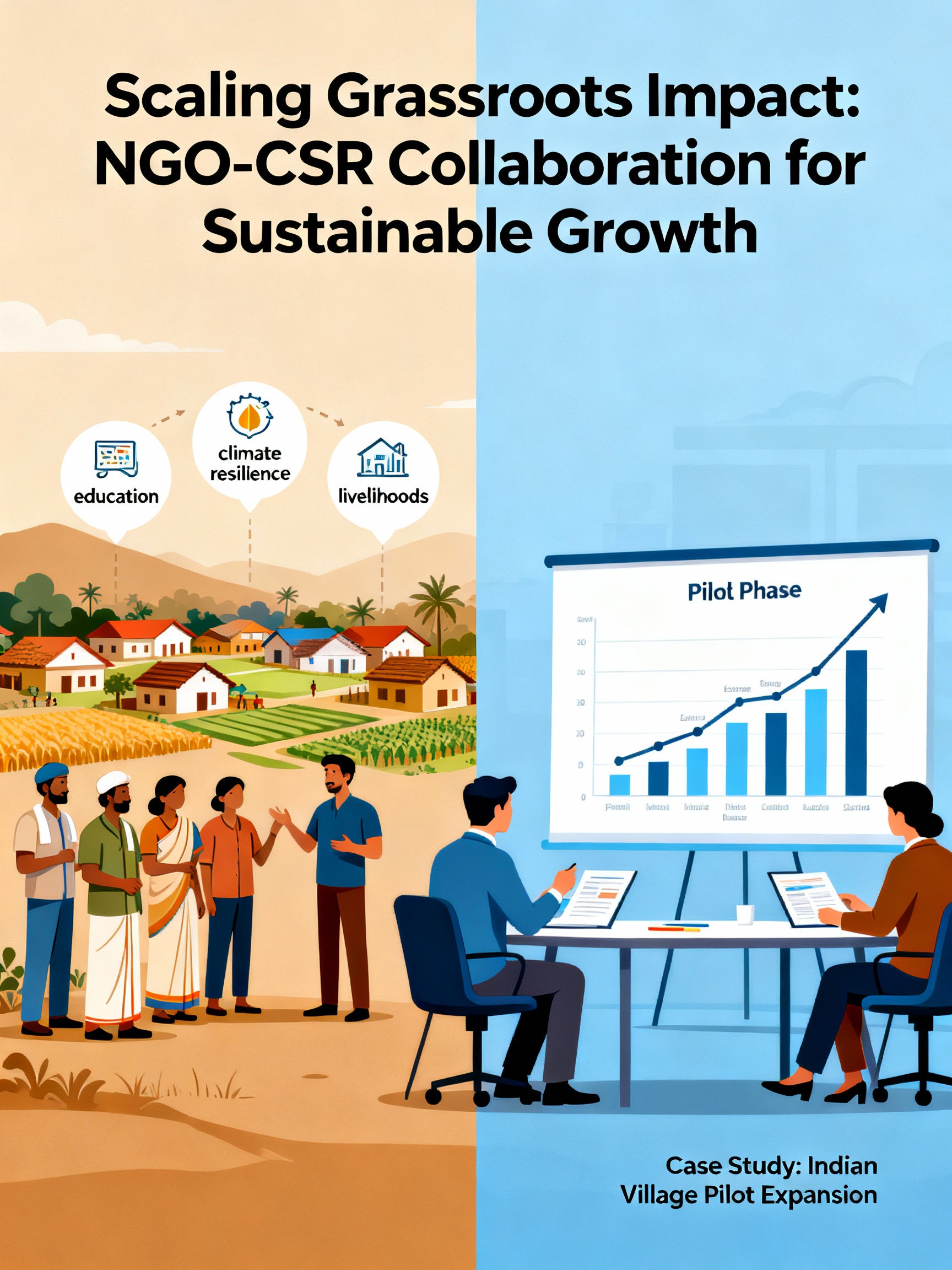
Corporates tend to back NGOs that can demonstrate scale, predictability, and a clear path for growth, but small, community-led organisations can absolutely position themselves as “scale-ready” with the right framing. The blog below turns your points into a coherent, NGO-facing article.
Why Corporates Prefer Big, Scalable Projects
Most CSR teams today are under pressure to show large numbers, multi-year impact, and alignment with business priorities. That often means they lean towards bigger, scalable programs rather than small, stand-alone projects, even when those smaller projects are incredibly deep and meaningful.
If you are a grounded, community-focused NGO, this can feel unfair. You do strong work in a few villages, schools, or slums, while corporates ask, “Can this go to 100 locations?” The good news: you do not have to change your DNA. You only need to change your design, language, and packaging.
Turn Small Projects into Flagship Programs
Instead of proposing many small, disconnected interventions, bundle them into a single, named program with a clear structure. This helps corporates see a unified model that can be replicated, rather than a collection of scattered activities.
- Convert multiple locations into one coherent program:
For example, “5 villages” can become a “Climate-Resilient Village Cluster Program,” or “10 schools” can become a “Model Education District Program.” - Define a clear program architecture:
Specify standard components (community mobilisation, capacity building, technology support, monitoring) that stay constant across any number of locations. - Show how scale works:
Make it clear that with more funding, you add more clusters or districts, not redesign the entire project each time.
When you do this, corporates start to see your work as a tested model with a scale-up pathway, not as a one-off activity.
Use a Pilot–Scale Journey CSR Teams Love
Most corporate funders are more comfortable when they can “test, learn, then scale” instead of committing big money upfront. You can use this to your advantage by designing every proposal as a journey.
- Year 1 as a pilot:
Offer a smaller-budget, tightly defined pilot in a limited number of locations, with strong learning, documentation, and proof of concept built in. - Years 2–3 for scale-up:
Lay out a clear pathway where, if the pilot meets agreed outcomes, the program expands to more villages, schools, or communities with a larger, multi-year budget. - De-risking for the corporate:
This positions the pilot as a low-risk entry, with a structured “if successful → we grow together” decision point that CSR teams and boards find easier to approve.
This approach also signals maturity: you are not just asking for funds; you are proposing a thoughtful, phased partnership.
Build a Strong Scalability Story Slide
In many CSR decisions, a single slide can make or break your proposal because it answers the unspoken question: “If this works, what next?” Every deck you share should have one powerful “Scalability Story” slide.
Include four simple elements:
- Current reach:
State where you are now (for example, 10 villages, 8 schools, 600 farmers). - Potential in the region:
Map the total opportunity (for example, 100 villages in the district, 200 schools in the block). - Unit economics:
Share the cost per unit: per village, per school, per farmer, or per SHG member so they can quickly see how funding converts into scale. - Funding scenarios:
Present 1x, 2x, and 4x funding scenarios: “At ₹X lakh, we reach Y villages; at ₹2X, we reach 2Y; at ₹4X, we cover the entire block.”
This one slide helps CSR teams visualise scale and justify larger ticket sizes internally.
Use Collaborations to Unlock Scale
Corporates increasingly look for projects that combine on-ground depth with technology, innovation, and market linkages. As a community-strong NGO, you do not have to build everything yourself; you can bring in partners.
- Partner with tech and content providers:
Collaborate with organisations that bring digital learning platforms, MIS systems, or specialised curricula while you lead implementation and community relationships. - Add market and livelihood linkages:
For livelihood and skilling, partner with entities that connect beneficiaries to markets, employers, or value chains, strengthening your value proposition. - Present a consortium proposal:
Submit one integrated program with clear roles: “Our NGO leads community mobilisation and field delivery; Partner A provides tech; Partner B provides market access.”
This turns your proposal into a “big solution” without losing your local strength.
Track the Right KPIs for Scale Readiness
To move from small grants to large, multi-year CSR partnerships, you need to track indicators that signal scale and strategic value, not just activities.
Consider focusing on:
- Average ticket size of CSR grants:
Monitor whether your average grant amount is rising over time as you adopt bundled programs and pilot–scale models. - Proportion of proposals with clear scale-up plans:
Track how many proposals now include pilot–scale journeys, funding scenarios, and scalability stories. Aim for this to be close to 100%. - Conversion of pilots to multi-year programs:
Measure the percentage of pilots that successfully convert into 2–3 year scale-up grants and use those stories as proof points in future pitches.
Over time, these KPIs help you demonstrate that you are not just doing good projects, but building investable, scalable programs corporates can grow with.
Quick Recap for NGOs
- Do not shrink your ambition just because your current footprint is small, package your work as a replicable program with clear unit costs and scale pathways.
- Always offer a pilot–scale journey that reduces risk for corporates while creating room for long-term partnership.
- Use collaborations and strong scale storytelling to show that supporting you is not just funding a project but investing in a scalable solution.
Written by Deb who is a social impact worker and part of letzrise team and stays in Bengaluru.