

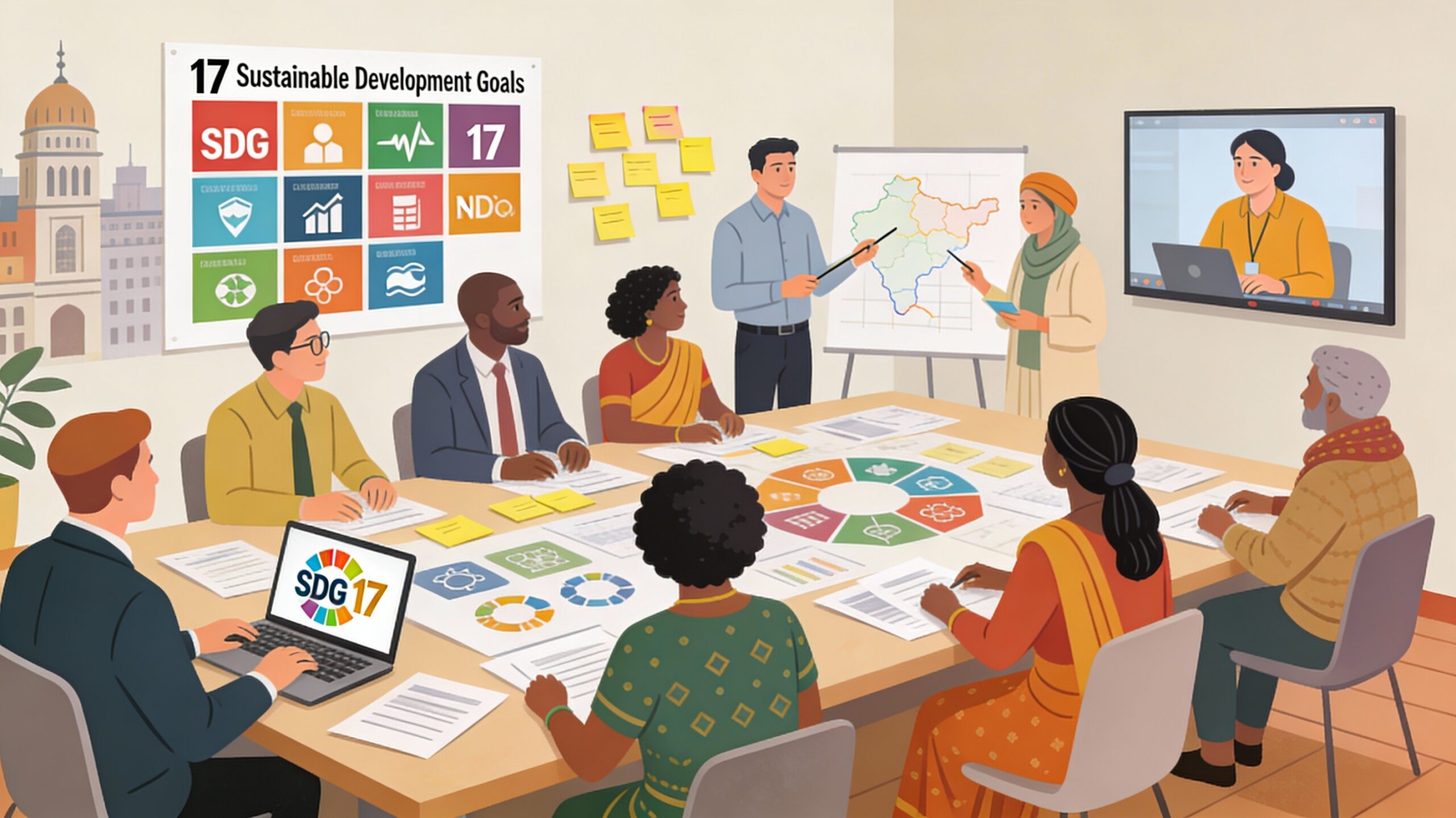
Sustainable Development Goal 17 is about “Partnerships for the Goals” and recognises that the SDGs can only be achieved when governments, business, and civil society work together. For NGOs, employee engagement is no longer just about feel-good volunteering days; it is a practical way to build multi-stakeholder partnerships that share knowledge, technology, and resources to advance community impact.
SDG 17 specifically calls for enhanced global partnerships that mobilise and share expertise, technology and finance, and for effective public–private–civil society partnerships (targets 17.16 and 17.17). When NGOs design employee engagement with this lens, corporate staff become partners in systems change instead of occasional volunteers.
Shift The Mindset: From One-Off Events To Partnership Journeys
Many CSR programs still treat employee engagement as a calendar of activities to be filled—clean-up drives, donation camps, or one-day visits. This event-driven approach rarely strengthens the NGO’s capacity or builds lasting value for communities, and it does not reflect the multi-year partnership spirit of SDG 17.
An SDG 17–aligned approach asks deeper questions: How can employees contribute strategic skills? How can engagement create new alliances—for example, between the corporate, other NGOs, start-ups, and local government? The goal is to move from “hours volunteered” to a shared partnership roadmap with clear roles, milestones, and learning on both sides.
Step 1: Anchor The Partnership in SDG 17
Start by explicitly naming SDG 17 in your CSR conversations, concept notes, and MoUs, so everyone shares a common language. Explain that SDG 17 is the backbone that helps unlock progress on other goals like health, education, climate, and livelihoods by connecting actors and resources.
Then link your proposed employee engagement to SDG 17 targets: 17.16 (multi-stakeholder partnerships that mobilise knowledge, expertise, technology, finance) and 17.17 (effective public–private–civil society partnerships). This framing helps CSR and HR teams see employee engagement as a strategic lever for their SDG commitments, not just an HR perk.
Step 2: Map Corporate Strengths And NGO Needs
SDG 17 emphasises sharing technology, knowledge, and capacity—not just funding. As an NGO, map your organisational pain points and growth opportunities: data systems, communication, community tools, process design, policy engagement, or field technology.
Parallelly, map the corporate partner’s strengths: sector expertise, tech and data teams, finance and legal, supply chain knowledge, communications, and leadership coaching. The sweet spot for SDG 17–aligned engagement is where NGO needs intersect with corporate skills, so employees contribute what they do best while strengthening community systems.
Step 3: Design A Year-Long Engagement Calendar
Instead of isolated events, curate a year-long employee engagement calendar that builds from awareness to co-creation. A simple structure could be: Q1 – learning and immersion, Q2 – skills-based volunteering, Q3 – co-creation and innovation, Q4 – reflection and scaling.
Each quarter, connect activities to SDG 17 language—“sharing technology,” “co-creating solutions,” “building capacity,” “forming new partnerships.” This helps employees see their journey as part of a larger global effort to strengthen the means of SDG implementation, not just an internal engagement initiative.
High-Impact SDG 17 Employee Engagement Formats
- Skills-Based Volunteering Clinics
Skills-based volunteering directly reflects SDG 17’s focus on mobilising knowledge and expertise across sectors. Corporate employees can run “clinics” where small, cross-functional teams support NGOs on strategic projects: financial planning, data dashboards, communication strategies, HR systems, or process mappings.
These clinics can be structured as 6–8 week sprints with clear problem statements, deliverables, and shared ownership between NGO and corporate champions. When documented well, each clinic becomes a case study of how partnerships improved institutional resilience and community outcomes.
- Co-Creation Labs And Innovation Sprints
Target 17.16 talks about partnerships that mobilise technology and innovation, which NGOs can translate into co-creation labs. Design 1–2 day labs where employees, NGO staff, and community representatives brainstorm and prototype solutions for real field challenges using design-thinking methods.
Outputs might include simple digital tools, low-cost hardware prototypes, new community outreach models, or data-collection frameworks. Follow up with a 3–6 month implementation phase where mixed teams refine and scale promising ideas, turning one-time events into living partnership projects.
- Multi-Stakeholder Roundtables And Site Dialogues
SDG 17 is explicitly about multi-stakeholder partnerships that bring together government, private sector, and civil society. NGOs can host roundtables or on-site dialogues where corporate employees interact with local officials, other NGOs, and community leaders to understand systemic barriers and explore joint solutions.
Employees might not “solve” problems in a single session, but they gain context, build relationships, and help open doors for new collaborations or policy engagement. Over time, these spaces deepen trust and can seed coalitions, joint pilots, or advocacy platforms under the SDG 17 banner.
- Peer Learning And Capacity-Building Exchanges
Targets under SDG 17 emphasise capacity-building and knowledge-sharing across countries and sectors. NGOs can design peer learning exchanges where corporate teams train NGO staff (and vice versa) on topics like digital tools, agile project management, inclusive leadership, or sustainability practices.
These exchanges can be structured as short “learning pathways” with 3–5 sessions, assignments, and joint reflection. When employees see that they are also learning from NGOs and communities, the partnership becomes more reciprocal and respectful.
Step 4: Build Governance And Shared Ownership
Effective SDG 17 partnerships require clear governance and shared accountability. Draft a simple partnership charter or MoU with the corporate partner that includes SDG 17 objectives, decision-making norms, and how employee engagement connects to broader CSR goals.
Set up a joint steering group with representation from CSR, HR, business units, and the NGO to track progress and troubleshoot. Include employee champions in this structure so engagement is driven bottom-up as well as top-down, mirroring UN guidance on multi-stakeholder implementation.
Step 5: Measure What Matters Under SDG 17
Traditional metrics focus on number of volunteers and hours contributed, which are useful but incomplete. For SDG 17–aligned employee engagement, add indicators that reflect partnership quality: knowledge products created, tools or systems implemented, new alliances formed, and policy or practice changes triggered.
You can also capture qualitative outcomes such as improved trust between sectors, enhanced NGO capacity, and employee understanding of systemic challenges. Linking these indicators back to SDG 17 targets makes your reporting stronger for CSR boards, ESG disclosures, and UN-aligned sustainability reports.
Step 6: Tell The Partnership Story, Not Just The Activity
SDG 17 emphasises data, monitoring, and accountability—but also the power of shared narratives to inspire further collaboration. When communicating about employee engagement, shift from “X employees volunteered Y hours” to stories of how the partnership built new capabilities, tools, or coalitions.
Feature voices from employees, NGO staff, and community leaders to show multiple perspectives on the same journey. Over time, this storytelling positions your NGO as a credible partner for SDG implementation, attracting more aligned corporates who want deeper, strategic engagement.
Closing: NGOs As Architects Of SDG 17 Partnerships
NGOs are uniquely placed to convene communities, understand ground realities, and translate corporate skills into meaningful impact. By redesigning employee engagement as a structured SDG 17 partnership journey—with clear roles, governance, and learning loops—NGOs help corporates move from cheque-writing and token volunteering to co-owning long-term solutions.
When employees experience themselves as co-creators, not visitors, they carry the SDG 17 mindset back into their business decisions, supply chains, and leadership roles. That is where employee engagement becomes a true force-multiplier for the Sustainable Development Goals, far beyond any single activity or project.
Written by Deb who is a social impact worker and part of letzrise team and stays in Bengaluru.