

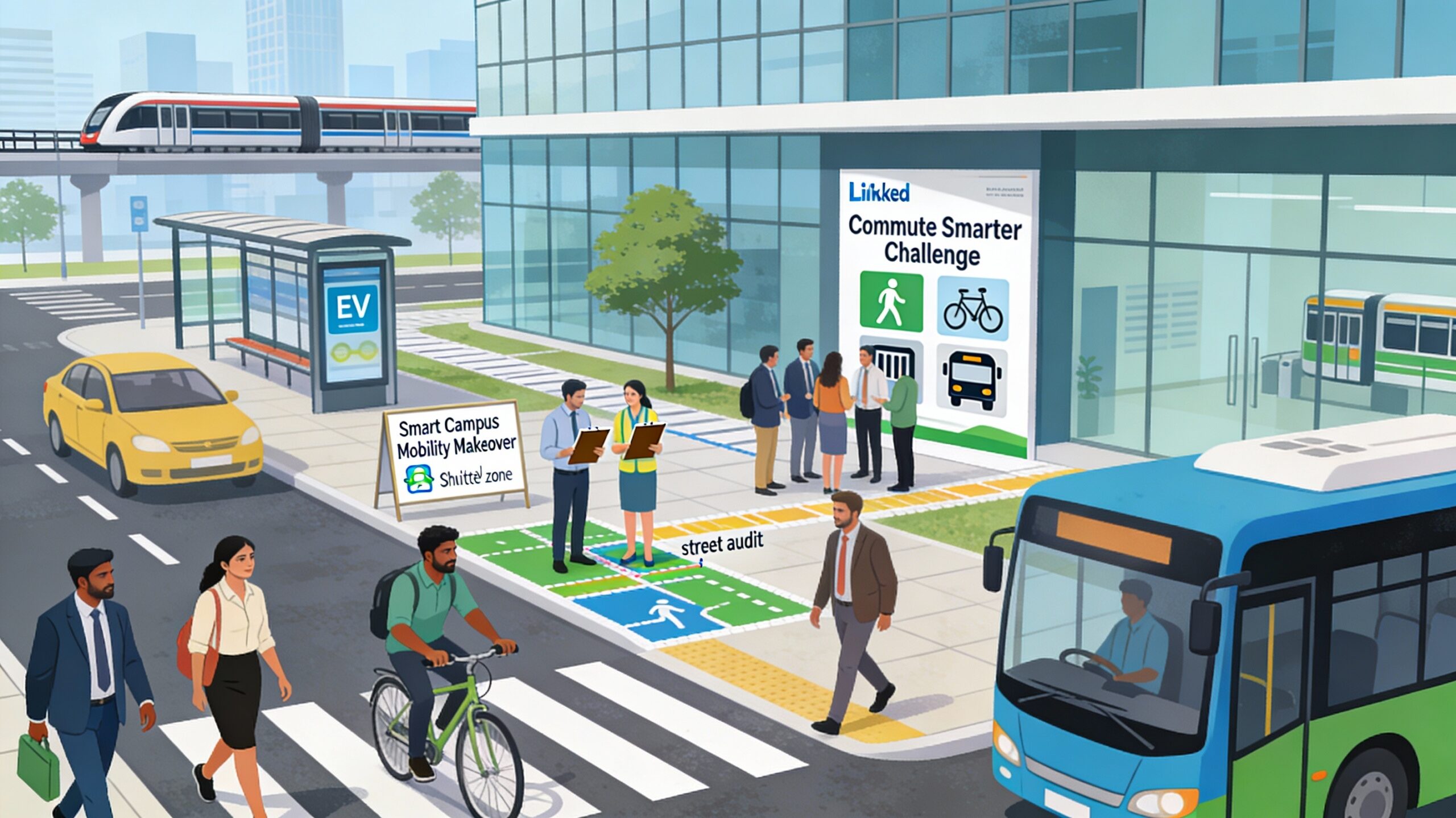
Smart city and mobility–themed engagement helps employees see themselves as everyday city-makers, not just commuters. The formats below are written so NGOs and corporate CSR / sustainability teams can plug them into annual engagement calendars. Both the team can design in collaboration the below mentioned themes to get their employees in the company engaged.
- “Commute Smarter” mobility challenge
Run a 2–4 week challenge where employees log how they travel each day (walk, cycle, metro, bus, carpool, solo car) via a simple form or app. Create friendly badges and a leaderboard for roles like “Car-Free Champion,” “First-Time Metro User,” or “Cycling Star,” and share weekly bite-sized insights on estimated CO₂ saved, time saved and cost benefits from sustainable modes. NGOs can support with emission calculators, nudge messages and a short debrief report.
- Smart city walk / cycle audit
Organise a guided “street audit” around the office so employees can experience their city’s footpaths, crossings, bus stops and cycle tracks more consciously. Give small groups a simple checklist covering safety, lighting, accessibility for people with disabilities, wayfinding and public transport access, then convert their observations into a short “micro-recommendations” note for local authorities or RWAs. Partnering with an active mobility NGO or city network adds technical depth and follow-up possibilities.
- “Design your 15-minute city” lab
Host a collaborative lab where small teams sketch their ideal 15-minute neighbourhood around home or office—places to work, learn, shop, access healthcare, play and connect to public transport within a short walk or cycle. Provide a simple template with “current state” and “ideal state,” encouraging ideas for safer walking/cycling routes, last-mile connectivity, green spaces and inclusive public areas. Outputs can be turned into concept notes for local CSR projects (e.g., supporting pedestrian improvements near offices or community hubs).
- Mobility innovation hackathon
Set up a one-day or multi-week hackathon where cross-functional employee teams work on real mobility challenges linked to partner communities or city corridors. Themes could include safer school streets, better last-mile connectivity to metro or bus, clearer information for public transport users, inclusive design for people with disabilities or EV-charging awareness. Teams prototype simple tools—apps, WhatsApp bots, signage, awareness campaigns or campus process tweaks—with the most feasible ideas piloted under CSR alongside city or NGO partners.
- “Future of mobility” learning series
Run a short learning series (onsite or virtual) that connects smart mobility trends to business, ESG and employee well-being. Topics can include public transport and integrated ticketing, walking and cycling for health, EVs and shared mobility, and how data shapes transport planning, with interactive polls on how employees travel today and what would help them switch to greener options. NGOs, city experts or mobility startups can be invited as speakers to keep content grounded and local.
- School routes safety volunteering
Partner with nearby schools and mobility NGOs to study the safety of routes children use at arrival and dispersal times. Volunteers observe traffic speeds, crossing behaviour, encroachments, signage and informal transport, then help create simple recommendations, awareness posters and pledge campaigns for parents and drivers. This activity links smart mobility, child safety and community engagement in a very visible way.
- Smart campus mobility makeover
Use the office or plant itself as a “micro smart city” lab. An employee task force maps internal movement patterns—parking, shuttle routes, pedestrian flows, wheelchair access, cycle parking—and co-creates 5–10 quick-win ideas like carpool zones, preferred parking for EVs/carpools, clearer pedestrian paths, better internal wayfinding and shuttle info dashboards. Over time, the company can track indicators such as reduced solo-car use, higher carpooling or improved commute-satisfaction scores as part of its ESG and employee experience dashboard.
Written by Deb who is a social impact worker and part of Letzrise team and stays in Bengaluru.